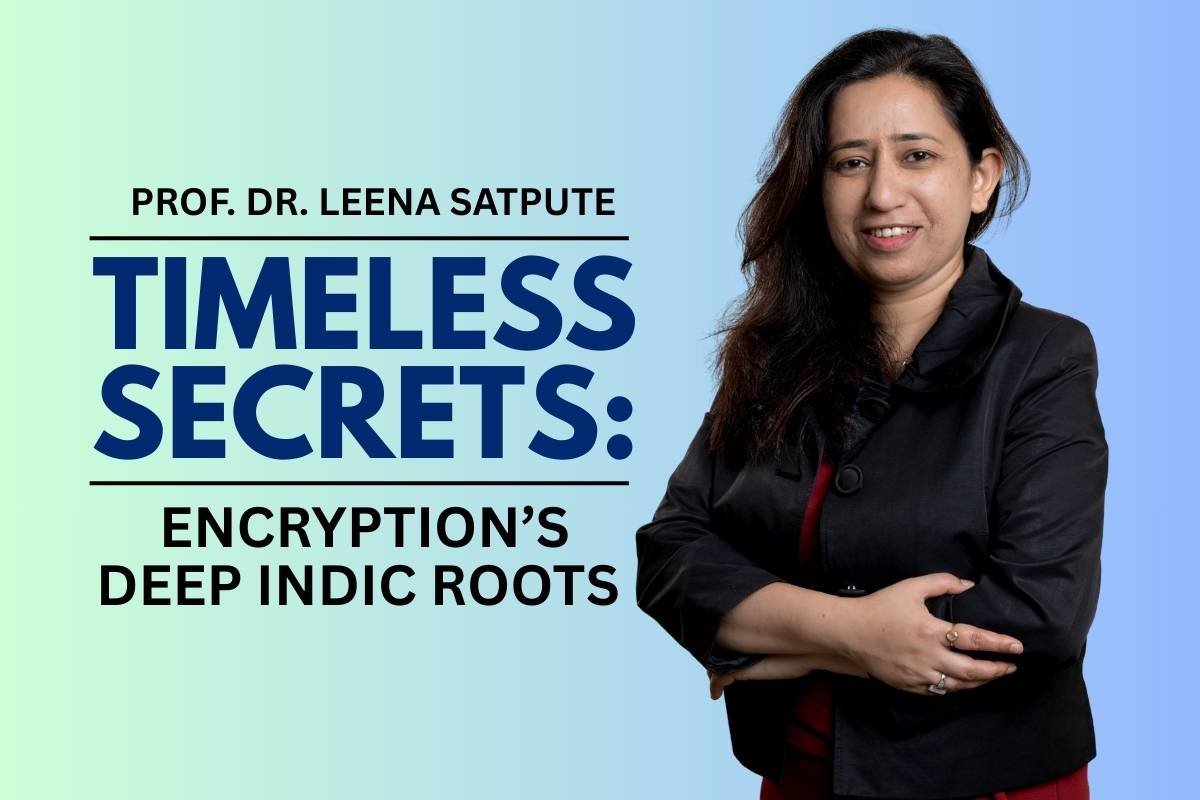


By- Prof. Dr. Leena Satpute
Modern cryptography is often traced back to classical Greek and Egyptian innovations, but the Indic civilization holds an equally compelling—yet under-recognized—heritage in encryption, information security, and intelligence systems. From Vedic numerical codes to Kautilya’s sophisticated espionage network, ancient India developed methods that parallel contemporary concepts of confidentiality, integrity, and secure communication. Today, as businesses confront rising cyber risks and prepare for a quantum-enabled future, these historical insights are more relevant than ever.
Numerical Systems Embedded in Literature
Vedic literature is revered for its spiritual and philosophical depth, but beneath the verses lies another layer: numerical coding. Sanskrit scholars developed multiple ways to encode numbers into text, allowing mathematicians and astronomers to preserve formulas, constants, and datasets in a form that was both compact and confidential.
Three systems stand out:
- KaTaPaYadi System
- Bhūta-saṃkhyā System
- Āryabhaṭa Numeration
These methods enabled information to be concealed within poetry, verses, and prose—essentially, ancient steganography.
The KaTaPaYadi Cipher
One of the most remarkable systems, KaTaPaYadi (origin debated but widely believed to have emerged around the 4th century CE), assigns digits 0–9 to Sanskrit consonants while leaving vowels unvalued. A word encoded using this method yields a numeric value that is read in reverse order—a simple but effective hashing technique.
For example:
- Bha = 4, Ra = 2, Ta = 6
- “Bharat” → Encoded as 624 → Hash value read as 426 → “Bharat”
This elegant system allowed scholars to remember long mathematical constants, astronomical values, and formulas by embedding them inside aesthetically appealing verse. It is also described in detail in Sadratnamala, written in the 18th century by Śaṅkara Varman.
Śrīrāmaśalākā: A 15×15 Matrix of Transposition and Steganography
Another sophisticated example of Indic cryptography is the Śrīrāmaśalākā, a transposition–substitution cipher that cleverly hides meaningful text within a 15×15 square matrix.
The process involves:
- Taking nine philosophical verses.
- Extracting letters sequentially—first letters of each verse, then second letters, and so on.
- Populating a 15×15 matrix with these characters.
Once scrambled, the verses become nearly unrecognizable. The matrix can be rearranged, rotated, or read through various paths, offering equal probability (1/9) of retrieving any verse—an early demonstration of probability-balanced encoding. Conceptually, this aligns with modern matrix manipulation techniques used in encryption algorithms.
Bhūta-saṃkhyā: Numbers Through Metaphor
Bhūta-saṃkhyā represents numbers through symbolic words or objects—for instance:
- 2 = “Eye”
- 32 = “Teeth”
Astronomers, astrologers, and mathematicians used this system to encode numerical data in verses that appeared metaphorical to casual readers but conveyed precise values to experts. This allowed knowledge transmission in a manner both mnemonic and secure.
Kautilya’s Espionage: An Early Framework for Intelligence Systems
While Vedic scholars developed cryptographic techniques, Kautilya (Chanakya) built one of history’s most structured intelligence networks, described in his seminal work, the Arthaśāstra. His model displays a level of strategic thinking comparable to modern intelligence agencies.
Key features of Kautilya’s system:
- Diverse agent profiles: monks, merchants, householders—each chosen for social mobility, credibility, and access.
- Role-based assignments: economic intelligence, military monitoring, local sentiment analysis, and more.
- Redundancy and cross-verification: intelligence was validated through multiple independent sources to ensure accuracy.
- Psychological and tactical training: spies were taught methods of persuasion, misinformation, and covert communication.
- Active counterintelligence: agents were tasked not only with gathering information but also with spreading disinformation and disrupting enemy plans.
In modern business terms, Kautilya’s system demonstrates early mastery of risk management, multi-layered verification, secure communication channels, and strategic information flow.
Gudhayojya: Concealing Messages in Plain Speech
Gudhayojya, another Indic cryptographic technique, altered spoken messages by adding extraneous syllables at the beginning or end of each word. Only trained listeners could parse the authentic content. This oral obfuscation is an ancient analogue of modern linguistic encryption or coded intelligence phrases.
Why These Ancient Techniques Matter Today
As businesses navigate the complexities of digital transformation, data privacy, cyber warfare, and the approaching quantum computing revolution, the ancient Indic systems offer valuable lessons:
- Steganography and obfuscation for secure data transmission.
- Multi-layered verification models akin to zero-trust frameworks.
- Memory-optimized encoding systems that inspire efficient algorithm design.
- Matrix-based transformations foundational to modern cryptographic computations.
- Strategic intelligence gathering and validation relevant for corporate risk, competitive intelligence, and national security.
The Indic civilization demonstrates that the principles of secure communication are not modern inventions but deeply rooted in human history.
Conclusion
The ancient Indic approaches to encryption, coding, and intelligence demonstrate that the fundamentals of secure communication have been understood for millennia. From poetic numerical systems like KaTaPaYadi to the strategic brilliance of Kautilya’s espionage network, these innovations reveal a civilization deeply invested in protecting knowledge and maintaining informational advantage.
As modern organizations confront unprecedented cybersecurity threats and prepare for the quantum era, revisiting these timeless systems offers more than historical insight—it provides strategic inspiration. The blend of simplicity, creativity, and structural rigor found in these ancient methods can inform the next generation of cryptographic designs and security frameworks. By integrating traditional wisdom with cutting-edge technology, businesses can build more resilient systems and ensure that the confidentiality, integrity, and trust essential to the digital economy remain uncompromised.