



India’s data story no longer lives quietly inside servers. It moves through courtrooms, boardrooms, trade negotiations, and geopolitics. What once appeared as an obscure regulatory idea, “data must reside within national borders,” has now become a defining feature of India’s digital governance strategy. Data localization is not merely about where information sits; it is about who controls value, power, security, and the future of the digital economy.
As India positions itself as a global digital powerhouse, data localization laws in india sits at the intersection of ambition and anxiety, offering opportunity while demanding difficult operational recalibration.
When Data Became Strategic Infrastructure?
Data today functions much like oil once did, but with a crucial difference. Unlike oil, data multiplies when used. It fuels artificial intelligence, financial inclusion, digital public goods, and platform economies. For India, a country generating vast volumes of personal, financial, and transactional data every second, the question is no longer whether data should be regulated, but who governs it and where it lives.
Localization emerged as a response to this reality. Policymakers began viewing unrestricted cross-border data flows as a vulnerability exposing citizens’ data to foreign surveillance regimes, jurisdictional conflicts, and corporate monopolies beyond India’s legal reach. The argument was simple yet powerful: data generated by Indians should be protected under Indian law.
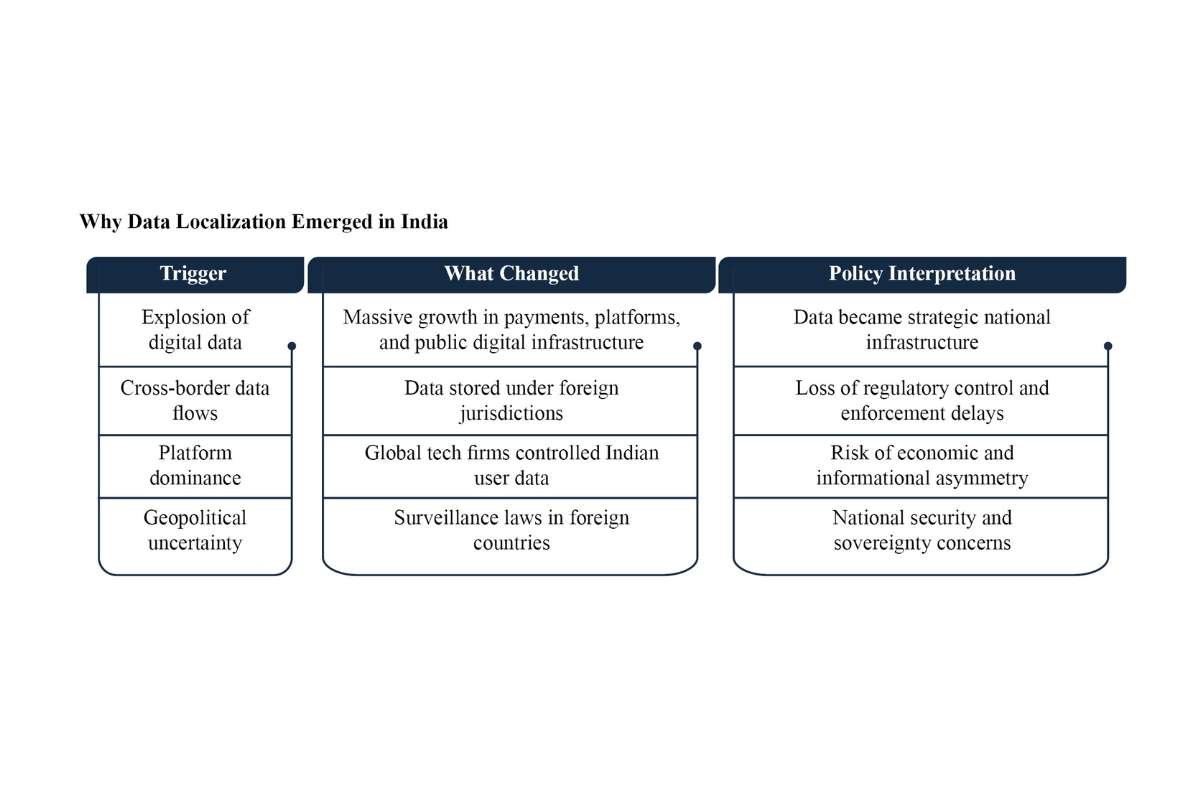
| Why Data Localization Emerged in India | ||
|---|---|---|
| Trigger | What Changed | Policy Interpretation |
| Explosion of digital data | Massive growth in payments, platforms, and public digital infrastructure | Data became strategic national infrastructure |
| Cross-border data flows | Data stored under foreign jurisdictions | Loss of regulatory control and enforcement delays |
| Platform dominance | Global tech firms controlled Indian user data | Risk of economic andinformational asymmetry |
| Geopolitical uncertainty | Surveillance laws in foreign countries | National security and sovereignty concerns |
The Quiet Evolution of Data Localization Laws in India
India did not impose data localization overnight. Instead, it unfolded through sectoral nudges and regulatory signals.
The Reserve Bank of India was among the first movers, mandating that payment system data be stored exclusively within India. This single directive reshaped the compliance strategies of global fintech firms and payment processors. Telecom regulations, insurance norms, securities market guidelines, and intermediary rules followed each embedding localization principles into sector-specific compliance.
Meanwhile, successive versions of India’s data protection framework consistently retained localization elements, especially for sensitive and critical personal data. Even as legislative drafts changed, the underlying policy intent remained clear: India was drawing a digital border.
Sovereignty in the Age of Servers
At its core, data localization laws in India are an assertion of sovereignty but not in the traditional territorial sense. This is sovereignty exercised over invisible flows: metadata, algorithms, consumer behavior, and financial trails.
For India, this matters deeply. When data is stored domestically, enforcement becomes tangible. Law enforcement agencies no longer rely on slow-moving mutual legal assistance treaties. Courts can demand compliance. Regulators can audit systems. Sovereignty shifts from theory to execution.
This control becomes particularly critical in areas like payments, national security, elections, and public infrastructure platforms. In an era where cyber warfare and data misuse can destabilize societies, localization is framed as defensive architecture.
The Economic Upside: Building the Data Spine

Localization has quietly triggered a new investment cycle. Hyperscale cloud providers, global data center operators, and domestic infrastructure firms have accelerated capacity creation across India. Cities like Mumbai, Chennai, Hyderabad, and Noida are becoming dense data clusters.
This infrastructure push is not cosmetic. It generates skilled employment, deepens India’s cloud ecosystem, and reduces dependency on offshore infrastructure. More importantly, it enables data-adjacent innovationfrom AI training models to real-time financial analytics built on domestically available datasets.
For Indian startups, localized data can become a strategic advantage. Access to domestic datasets, lower latency, and regulatory alignment can level the playing field against global incumbents who once dominated purely through scale.
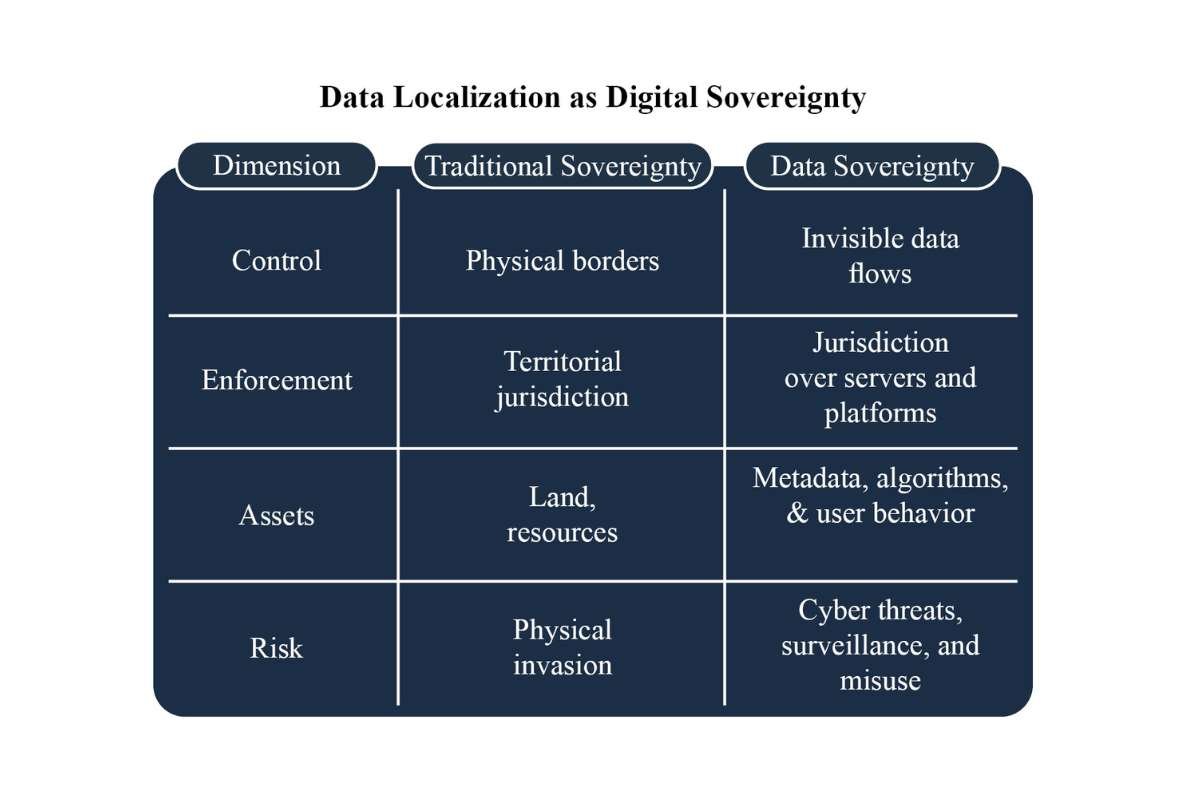
| Data Localization as Digital Sovereignty | ||
|---|---|---|
| Dimension | Traditional Sovereignty | Data Sovereignty |
| Control | Physical borders | Invisible data flows |
| Enforcement | Territorial jurisdiction | Jurisdiction over servers and platforms |
| Assets | Land, resources | Metadata, algorithms, and user behavior |
| Risk | Physical invasion | Cyber threats, surveillance, and misuse |
Trust as an Economic Asset
Data localization is also an exercise in rebuilding trust between citizens and platforms, users and institutions.
Public confidence in digital systems hinges on the belief that personal data is not being arbitraged beyond accountability. Localization reinforces the idea that Indian users are protected by Indian law, not subject to opaque foreign jurisdictions.
This trust dividend is subtle but powerful. It strengthens adoption of digital public infrastructure, fintech platforms, health-tech services, and e-governance systems. In a country where scale depends on trust, localization acts as a confidence multiplier.
The Cost of Drawing Borders in a Borderless World
Yet, the operational reality is far more complex.
Global digital services are built on distributed architectures. Data flows seamlessly across regions to optimize cost, speed, and resilience. Localization disrupts this design. Companies must now re-engineer systems to isolate Indian data, often duplicating infrastructure and fragmenting databases.
For multinational firms, this increases capital expenditure and operational overheads. For startups, especially SaaS and AI-driven firms, localization can distort growth models that rely on unified global datasets.
Compliance costs do not fall evenly. Large firms absorb them; smaller players struggle. This asymmetry risks entrenching incumbentsthe very outcome localization often seeks to prevent.
Innovation Under Constraint
Data thrives on aggregation. Machine learning systems improve when exposed to diverse, cross-border datasets. Localization, if applied rigidly, can unintentionally starve innovation by creating data silos.
Sectors like healthcare, climate research, and advanced analytics depend on global collaboration. Restrictive localization can slow research partnerships, limit access to global tools, and reduce competitiveness in emerging technologies.
The challenge, therefore, is not localization versus innovationbut how localization is designed. Poorly calibrated rules can trade long-term innovation for short-term control.
Security is Not Guaranteed by Geography
A persistent misconception is that data becomes secure simply by being stored domestically. In reality, security depends on encryption standards, access controls, incident response systems, and cyber resilience not latitude and longitude.
Centralizing data within a single geography can, in fact, create concentration risks. Natural disasters, power disruptions, or coordinated cyberattacks could have an outsized impact if redundancy strategies are weak.
Localization without parallel investment in cybersecurity standards risks becoming a symbolic exercise rather than a substantive one.
Trade, Diplomacy, and Digital Friction

Data localization laws in India also have international implications. Cross-border data flows underpin global trade, services exports, and digital commerce. Restrictive localization is often perceived as protectionist, triggering friction in trade negotiations.
India must navigate this terrain carefully. As it seeks deeper integration into global digital trade frameworks, it will face pressure to reconcile domestic localization mandates with international interoperability commitments.
The real test lies in crafting a framework that protects national interests without isolating India from global digital value chains.
Sectoral Realities: One Rule Does Not Fit All
The impact of localization varies dramatically by sector.
Financial services benefit from stronger regulatory oversight but bear heavy compliance costs. Healthcare gains privacy protection but faces collaboration barriers. E-commerce grapples with fragmented analytics. Telecom and social media platforms must rework data pipelines entirely.
This diversity underscores the need for graduated, risk-based localization, rather than blanket mandates. Sensitivity, scale, and systemic risk must shape policy, not ideological uniformity.
Towards a More Nuanced Localization Strategy
Data localization laws in India’s journey are still unfolding. Its success will depend less on the principle itself and more on execution.
Clarity is paramount. Businesses need predictable rules, defined timelines, and unambiguous compliance pathways. Ambiguity is the costliest form of regulation.
Flexibility matters equally. Secure cross-border transfers, adequacy frameworks, and trusted country arrangements can preserve global integration while retaining sovereign control.
Most importantly, localization must be paired with investments in cybersecurity, regulatory capacity, judicial expertise, and digital skills. Data governance is only as strong as the institutions enforcing it.
The Bigger Picture
Data localization laws in India are not a retreat from globalization; it is an attempt to renegotiate its terms. It reflects a country asserting that digital growth must align with democratic accountability, economic inclusion, and national resilience.
The challenge ahead is balance. Excessive rigidity risks slowing innovation and investment. Excessive openness risks erosion of control and trust. Between these extremes lies a narrow but navigable path.
India’s ability to walk it will determine whether data localization laws in India become a catalyst for digital leadership or a constraint on the very future it seeks to secure.