

A strong business relies on moving goods quickly and smoothly. To do this, you must master the seven components of supply chain management. Every part, from sourcing raw materials to helping customers, connects like gears in a machine. If one part fails, you lose cash. Track your numbers monthly and use simple tools to keep your network safe. Read the full guide now to protect your profits.
You have to move your products fast to keep your business alive; that’s today’s reality. And this is why the components of supply chain management are so important today. Many brands fail because one single part of their chain breaks down. They can make great sales but still run out of cash.
A good chain links your raw goods straight to your buyers. Today, these paths face big shifts from new tech and green goals. Global risks, like wars, also change how we move items from place to place. Both small shops and large companies must build strong networks now.
Today, you will learn how to build that strength. We will look at each step that keeps your business safe. You will see how to smooth out your day-to-day work. Let’s get right into it!
What Are the Components of Supply Chain Management?
Think of gears in a machine. If one gear stops, every other part slows down right away. This is why supply chain management components must work as one. They cannot run on their own if you want to win.
Each piece connects to the next to form a smooth flow. We can chart this path to see how your goods move. The journey starts when you get raw items from your top supplier. Next, your procurement team buys what you need to build things.
Then, manufacturing turns those raw items into your main goods. Your inventory team tracks the stock so you do not run out. After that, logistics ships the final goods out to the buyers. The customer gets the order and sends back their true thoughts. This feedback helps you fix errors and make the next run better.
You must watch each step to keep the whole loop strong. When these links stay tight, your brand can scale up fast.
The Seven Core Components of Supply Chain Management
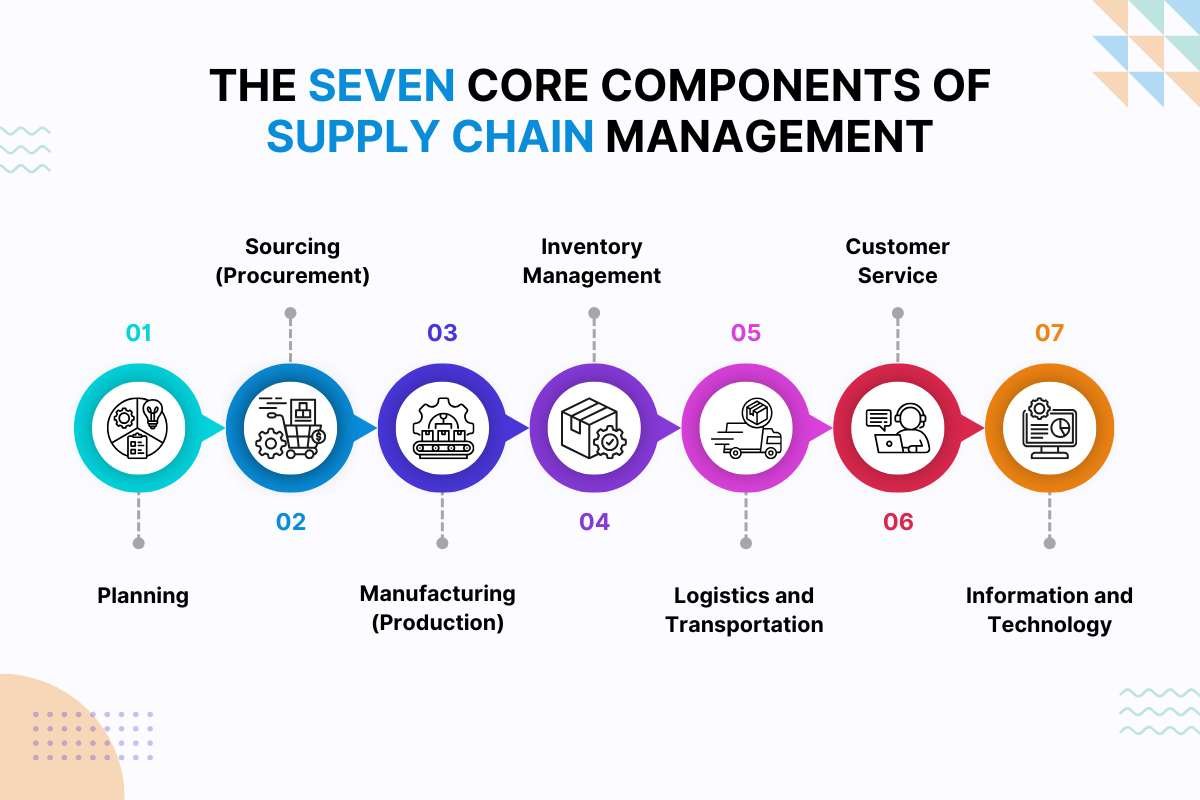
Each step in your network must fit together perfectly to prevent sudden losses. If we look at a study on supply chain, we find seven main components that work in unison.
We use these core components as the main pillars you need to watch.
1. Planning
You must look ahead to see what your buyers want from you next year. Demand forecasting helps you guess how many items you will need to make. You also use capacity planning to see if your team can handle the work. Sales forecasting maps out your cash flow so you can grow with ease. Finally, risk planning helps you prepare for bad days before they hit your team.
- Forecast Accuracy (%): Measures how close your sales guesses match your real results.
- Planning Cycle Time: Tracks the total days it takes to create your next run.
- Inventory Turnover: Shows how many times you sell and replace your stock.
- Service Level: Counts the share of orders you deliver on time without errors.
Poor planning hits your inventory fast because you buy the wrong amount of goods. Your procurement team wastes cash, and your warehousing costs spike right away. This chain of errors drops customer satisfaction down to a dangerously low point.
Small Business Tip: You do not need to buy costly systems to plan your work well. Simple spreadsheets and cheap forecasting software work well when you’re starting your brand.
2. Sourcing (Procurement)
You must pick the right partners to get your raw items on time. Vendor selection helps you judge which suppliers can deliver the best quality materials. Strong supplier relationships help you gain better terms and support when text shortages hit. You also need contract management to keep all your legal deals clear and safe. Good cost negotiation keeps your spending low, so you make a high profit.
- Supplier Lead Time: Measures the total days from your order to delivery at your dock.
- Supplier Defect Rate: Tracks the share of damaged items that arrive in each batch.
- Purchase Price Variance: Compares the real price you paid to your planned budget goal.
- Supplier Reliability: Counts how often your vendor hits their delivery promises each month.
When you use poor suppliers, you create massive inventory shortages for your shop floor. Your team cannot build goods if the raw parts do not show up.
Small Business Tip: Do not spread your budget across too many cheap vendors at the start. Start with fewer reliable suppliers to build a strong bond that protects you.
3. Manufacturing (Production)
You must transform your raw parts into finished goods with great speed and care. Production scheduling maps out which items your team will build every single day. You need strict quality control to catch flaws before they reach the public. Good resource utilization ensures you do not waste labor, power, or expensive factory space.
- Overall Equipment Effectiveness (OEE): Measures how well your factory tools perform against full capacity.
- Production Cycle Time: Tracks the time it takes to build one unit from start to finish.
- Scrap Rate: Counts the amount of raw material you throw away during assembly steps.
- First Pass Yield: Shows the share of products built correctly with zero rework needed.
If your plant slows down, production delays instantly ruin all your delivery promises. You cannot ship items on time when your assembly lines stop running smoothly.
Small Business Tip: You should apply lean manufacturing principles to eliminate waste in your work. Focus only on steps that add direct value to your final product.
4. Inventory Management
You must track your stock carefully so you do not freeze your cash. Safety stock acts as a shield to protect you when demand spikes. You set reorder points to know exactly when to buy more parts from vendors. Full inventory visibility allows your team to see stock levels across all locations live.
- Inventory Turnover: Measures how fast you sell through your current stock each year.
- Days Inventory Outstanding: Counts the average number of days you hold goods before sale.
- Stockout Rate: Tracks how often customers try to buy items that are completely missing.
- Carrying Cost: Calculates the total fee to store, insure, and protect your unsold goods.
If you hold too much inventory, you tie up cash you need for daily bills. Yet, if you hold too little inventory, you lose sales to other brands.
Small Business Tip: Adopt simple inventory software before you expand your store into new regions. Knowing your real numbers prevents huge losses when your order volume grows.
5. Logistics and Transportation
You must move your finished products to the right place at the right time. Shipping involves picking the best trucks, planes, or trains for your cargo load. Warehousing keeps your goods safe and organized until a buyer makes a purchase. Route optimization helps your drivers find the fastest paths to save on fuel costs. Last-mile delivery focuses on the final trip straight to the customer’s front door.
- On-Time Delivery: Tracks the percentage of shipments that arrive by the promised hour.
- Transportation Cost per Shipment: Measures the total spend to move one order to its place.
- Order Cycle Time: Counts the hours from the moment a buyer clicks pay to delivery.
- Delivery Accuracy: Shows how often you send the exact right items to the buyer.
Delayed logistics increases customer complaints and pushes people to leave bad reviews online. Your brand image drops fast when deliveries fail to show up as promised.
Small Business Tip: Use third-party logistics providers (3PLs) instead of owning your own fleet and warehouses. This choice saves you big upfront cash while you test new markets.
6. Customer Service
You must care for your buyers after they hand over their hard-earned money. A smooth returns process makes it easy for people to send back the wrong items. Quick complaint handling turns angry buyers into loyal fans who trust your name. Live order tracking gives people peace of mind while they wait for their boxes. Good after-sales support ensures your users get the most value from their purchase.
- Net Promoter Score: Measures how likely your buyers are to recommend you to friends.
- Customer Satisfaction: Tracks how happy users are with their recent service experience.
- Return Rate: Counts the share of sold items that buyers send back to you.
- Perfect Order Rate: Shows the percentage of orders delivered with zero errors or delays.
When you listen to customer feedback, you get the data you need to improve forecasting. Your buyers tell you exactly what you should change for the next run.
Small Business Tip: Automate customer notifications to send tracking links right after a sale wraps up. This step keeps buyers informed without draining your small support team’s time.
7. Information and Technology
You must connect every single node of your network with digital tools. An ERP system acts as the central brain that stores all your business data. Specialized SCM software helps you track shipments and manage your vendors with ease. Advanced tools like AI can predict market shifts before they happen in real time. Smart IoT sensors let you monitor the temperature of goods during transit. Cloud analytics turns raw numbers into clear charts you can use to make choices.
- Data Accuracy: Measures how well your digital records match the real physical stock.
- Order Visibility: Tracks the share of shipments you can follow live on a map.
- System Uptime: Counts the hours your software stays online without crashing or freezing.
- Forecast Accuracy Improvement: Shows how much your new tech reduces error in your plans.
Technology connects every SCM component so your teams do not work in the dark. Without these tools, your communication breaks down and operations grind to a halt.
Small Business Tip: Start with cloud-based SCM software that offers low monthly rates for small teams. You can scale up your tech plan as your sales numbers grow.
How Does Every Supply Chain Component Affect the Others?

You must look at your operation as one big system rather than distinct departments. When you optimize each branch alone, you often create hidden blocks down the line. We can map out these linkages to see how they impact your work.
| Component | Direct Impact On | Example |
| Planning | Procurement | Better demand forecasts reduce overbuying |
| Procurement | Production | Late suppliers delay manufacturing |
| Manufacturing | Inventory | Slow production lowers stock levels |
| Inventory | Logistics | Stockouts delay deliveries |
| Logistics | Customer Service | Shipping delays increase complaints |
| Customer Service | Planning | Customer feedback improves forecasting |
| Technology | Every Component | Real-time data improves decisions |
As this table shows, a single mistake ripples through your whole business setup. If your buyers change their minds, your procurement team must react fast. A delay in your raw parts will stop your factory lines cold. Then, your warehouse sits empty, and your logistics team cannot ship out goods.
This chain reaction shows why the components of supply chain management rely on unity. You cannot let teams work in the dark if you want to scale. True growth happens when all your data flows smoothly between every single step.
How Small Businesses Can Successfully Implement Supply Chain Management Components?
You do not need to buy a massive enterprise ERP system on day one. Small brands can win by taking small, smart steps with their tools. Let us break down how you can set up these workflows with ease.
1. Start With Process Mapping
You must trace your physical goods from the source straight to the buyer. Draw each touchpoint on paper so you can spot where delays happen. This clear map shows you which steps need the most help right now.
2. Use Affordable Cloud Tools
Link simple inventory software with your day-to-day accounting tools and your CRM. Cheap cloud setups give you full visibility without a massive price tag. These apps grow as your sales volume starts to climb.
3. Track KPIs Monthly
Pick four main metrics like order accuracy and stock turnover to watch closely. Review these numbers every four weeks to see where your team slips up. Regular checks help you fix small leaks before they cost you big cash.
4. Build Strong Supplier Relationships
Treat your vendors as true partners rather than just a line on a bill. Pay them on time so they prioritize your orders when shortages hit the market. Close bonds protect your shop floor from sudden parts shortages.
5. Automate Repetitive Tasks
Deploy basic shipping software to print out your cargo labels with one click. Send automated tracking notes to your buyers as soon as boxes leave the dock. AI in supply chain management frees up your time so you can focus on scale.
Common Mistakes Businesses Make When Managing SCM Components

There are many reasons why things go wrong in SCM. The research shows that poor sync creates deep breaks across your whole operation. Many brands judge their departments on single goals instead of end-to-end performance. This isolated view creates massive blind spots in your day-to-day work.
First, overstocking happens when your teams guess what your buyers want next season. Second, poor supplier diversification leaves you open to massive risks if one vendor shuts down. Third, ignoring customer feedback means you build items that no one wants to buy.
Fourth, relying on manual spreadsheets everywhere slows down your speed and introduces human error. Finally, a complete lack of contingency planning leaves you stuck when big market shocks hit your path.
To keep your components of supply chain management working in sync, you have to fix these mistakes.
Conclusion:
To end it all, let’s understand that you must view your network as one single loop where all parts connect. Optimizing one component is not enough to keep your business safe today. You must measure, monitor, and continuously improve all the components of supply chain management to win.
Deep technology and data visibility are now your primary competitive advantages in the market. They give you the live insights you need to prevent sudden errors. Brands that use these tools well will stay far ahead of their rivals.
Building a resilient, customer-centric supply chain will protect your profits through any future shock. Keep your data clear and your teams linked to drive home success.
For Further Reading: Supply Chain Management Essentials to Stop Your Operations From Breaking
People Also Asked:
Can small businesses implement supply chain management?
Yes, small shops can easily set up these workflows without spending big cash on corporate tools. You can start by mapping your steps on paper and using basic cloud apps to track your stock.
Which KPIs should companies track for supply chain management?
You should monitor forecast accuracy, inventory turnover, on-time delivery rates, and your perfect order scores each month. Tracking these specific numbers helps you find and fix bottlenecks before they cost you heavy sales.
How has technology changed the components of supply chain management?
Modern tech tools link every single department together with live data updates and clear digital tracking maps. This connectivity allows brands to spot shipping delays fast and adjust their production plans in real time.