
It is often without notice. A child watches a parent worry about bills at the dining table. A teacher emphasizes the importance of good grades, a stable job, and a secure future. Somewhere along the way, a belief settles in: work hard, earn steadily, and life will take care of itself.
Years later, that child grows into a professional. The salary increases, the responsibilities multiply, and yet, a quiet question lingers: If everything is going right, why does it still feel like something is missing?
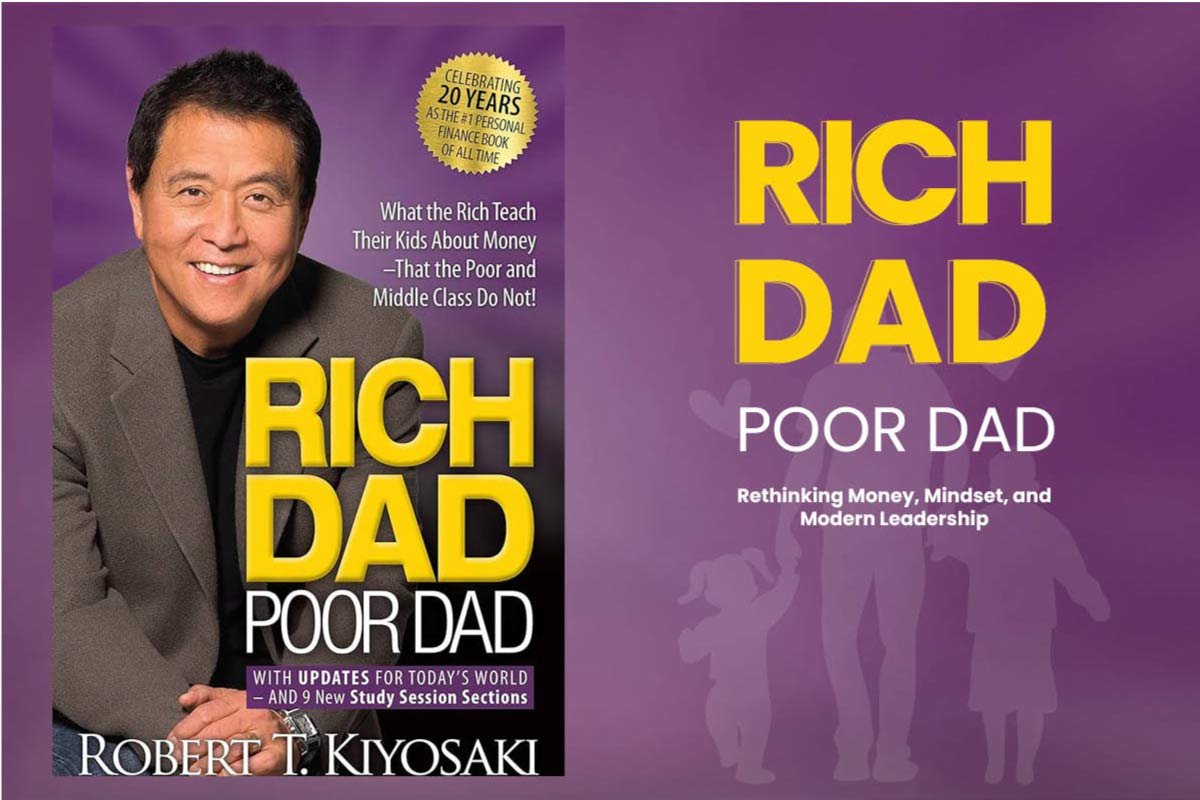
This is where Robert Kiyosaki steps in. Not with answers, but with a story. A story about two fathers. Two mindsets. Two completely different definitions of what it means to be rich.
Two fathers, one reality
In Rich Dad, Poor Dad, there are no villains. Only perspectives. The “poor dad” is familiar. Educated, hardworking, respected. He believes in stability, in climbing the ladder, in playing by the rules. His advice is practical, safe, and widely accepted. The “rich dad,” however, speaks a different language. One that feels uncomfortable at first. He questions the system. He challenges the idea that a job is the ultimate goal. He doesn’t dismiss education, but he insists that financial education is the one subject most people never truly learn.
Between these two voices lies a tension, one that many readers recognize instantly. Because in truth, these voices do not belong to two different people. They exist within us. Every financial decision, every risk avoided or taken, every opportunity ignored or pursued; it is often one of these voices guiding the choice.
The illusion of wealth
There is a moment in the book that shifts everything. It is the realization that not everything that looks like wealth actually is. A bigger house, a newer car, a lifestyle that appears successful from the outside. These are often celebrated as milestones. But beneath the surface, they may quietly demand more, more payments, more obligations, more dependence on a steady paycheck.
The idea introduced is deceptively simple: An asset puts money in your pocket. A liability takes money out. And suddenly, the narrative changes. Wealth is no longer about what is owned. It becomes about what is created. About what continues to grow, even when one is not actively working for it. It is not a rejection of comfort or success, but a redefinition of it.
Author’s perspective: the mind behind the message

- Primary Voice: Robert Kiyosaki
- Background: Entrepreneur, investor, and financial educator known for challenging traditional views on money and wealth creation
- Key Achievement: Author of one of the most influential personal finance books globally, sparking a shift in how millions perceive financial independence
- Core Philosophy: Financial freedom is not achieved through income alone, but through financial intelligence, understanding how money works, and making it work for you
- Writing Lens: Story-driven, belief-challenging, and rooted in real-life contrasts rather than technical instruction
- Signature Approach: Simplifying complex financial ideas into relatable narratives that question societal conditioning around jobs, security, and success
The moment of shift
There comes a point, sometimes subtle, sometimes sudden, when a person begins to see things differently. It might be after reading a single chapter. Or after recognizing a pattern in one’s own life. The realization that working harder is not always the same as moving forward. This is the moment Rich Dad, Poor Dad quietly prepares its reader for.
The shift from asking. “How much do I earn?” is asking, “How does my money grow?” from seeking security to building independence. But this shift is not easy. It requires confronting fears that are rarely spoken about, the fear of losing money, of making mistakes, of stepping away from what feels safe. And yet, it is within this discomfort that growth begins.
Lessons that stay long after the last page
What makes the book memorable is not just what it teaches, but how it lingers. The idea that financial education is a personal responsibility, not something that can be outsourced or delayed. The reminder to focus on building something of one’s own, even while working for someone else. The encouragement to see failure not as an endpoint, but as part of the process.
These lessons do not demand immediate action. Instead, they plant a seed. One that grows slowly, often reshaping decisions over time. A reader may not walk away with a detailed investment plan. But they walk away with something arguably more powerful, a different way of thinking.
A story that feels more relevant
Decades after its release, the story continues to resonate. Because the world it speaks to has evolved, but the challenges remain. People are earning more, yet questioning more. Opportunities have expanded, but so have uncertainties. The rise of side hustles, digital platforms, and independent ventures reflects a growing desire for control, over time, over income, over direction. And within this landscape, the ideas from Rich Dad, Poor Dad find new meaning. It is no longer just about becoming rich. It is about becoming aware.
Reader’s reflection: a review beyond the pages
What makes Rich Dad Poor Dad impactful is not just what it teaches, but what it makes the reader feel. For many, the book acts as a moment of pause. A realization that, despite working hard, financial clarity may still be missing. It challenges the comfort of routine and introduces a subtle discomfort, the awareness that effort alone does not always translate into growth.

“Rule One. You must know the difference between an asset and a liability, and buy assets. It is Rule No. 1. It is the only rule.” Simple, blunt, and sprinkled with a bit of controversy (according to some), Rich Dad Poor Dad is an important wake-up call for all of us… Review to come. “Most people, given more money, only get into more debt.” ~ Tharindu Dissanayake
Where the narrative sparks debate?

While Rich Dad Poor Dad has inspired millions, it has also drawn its share of criticism, an important aspect that adds balance to its influence. One of the most common critiques is its lack of actionable depth. The book focuses heavily on mindset but offers limited step-by-step guidance on how to build wealth in practical terms. For readers seeking concrete investment strategies, the insights may feel abstract.
Additionally, some critics point out that the storytelling is anecdotal, with limited factual verification of the “rich dad” figure. This raises questions about how much of the narrative is literal versus symbolic. There is also the argument that the book oversimplifies financial concepts, particularly when distinguishing between assets and liabilities, which in reality can be more nuanced.
Between inspiration and criticism
Like any widely read book, it invites both admiration and critique. Some argue that its ideas are too simplified. It offers inspiration without enough instruction. And in many ways, that is true. But perhaps that is also its intention. It does not aim to be a manual. It aims to be a mirror. A mirror that reflects not just financial habits, but underlying beliefs. One that asks uncomfortable questions without forcing immediate answers.
Who is this book for?

Rich Dad Poor Dad is best suited for readers at the beginning of their financial awareness journey. It speaks to young professionals, aspiring entrepreneurs, and individuals stuck in the paycheck cycle, offering a fresh perspective on money and wealth-building. It is also valuable for leaders and decision-makers looking to rethink financial independence beyond traditional income models.
However, those seeking advanced investing strategies or technical guidance may find it limited, as the book focuses more on mindset than execution. At its core, it is for anyone ready to question how they think about money.
Thank You For Reading!
See More
Book Review: The Psychology of Money by Morgan Housel