




International trade is more than the exchange of goods; it is a contest shaped by pricing power and access to markets. In this arena, pricing strategies can decide whether industries thrive or vanish. One such strategy is dumping, the practice of exporting goods at prices lower than their normal value, often below domestic prices or even production costs, to capture foreign markets.
For a growing economy like India, this practice raises serious concerns. Indian manufacturers frequently face artificially cheap imports that undercut fair competition, threaten domestic production, disrupt employment, and discourage long-term investment. This article examines India’s anti-dumping regime, exploring its legal framework, enforcement mechanisms, procedural safeguards, impact on domestic industries, and the policy challenges involved.
Conceptual Basis of Dumping and Anti-Dumping
Understanding dumping requires balancing legal precision with economic fairness.
Indian Anti dumping law operates as a corrective tool, not a trade barrier.
1. What Constitutes Dumping
In trade law, dumping occurs when goods are exported to India at a price lower than their normal value, meaning the comparable price of the product in the exporter’s domestic market. Dumping may exist even if export prices remain above production costs, provided they undercut home-market prices.
2. Why Anti-Dumping Duties Exist
Anti-dumping duties are remedial rather than punitive. Their objective is to offset injury caused by unfair pricing and restore competitive equality, not to shield domestic industries indefinitely.
3. The WTO Foundation
The legal basis lies in Article VI of GATT 1994 and the WTO Anti-Dumping Agreement, which allows duties where dumping causes material injury.
4. Limits of the Remedy
Such duties cannot exceed the dumping margin and usually lapse after five years unless renewed.
5. Distinct from Other Remedies
Anti-dumping differs from safeguards and countervailing duties, as it targets price discrimination, not import surges or subsidies.
While the theory of anti-dumping is globally shared, its real impact depends on how each nation gives it legal effect, India being no exception.
Legal Architecture of India’s Anti-Dumping Regime
Indian anti dumping law is anchored in a clear statutory and institutional structure designed to align domestic trade remedies with international obligations. The primary legal authority flows from Sections 9A and 9B of the Customs Tariff Act, 1975, read with the Customs Tariff (Identification, Assessment and Collection of Anti-Dumping Duty) Rules, which empower the government to investigate dumping and impose duties where warranted.
Institutionally, the Directorate General of Trade Remedies (DGTR), functioning under the Ministry of Commerce and Industry, serves as the investigative authority. It examines complaints, conducts detailed inquiries, and issues reasoned recommendations. Investigations are typically initiated upon applications by domestic producers alleging dumping. This is followed by a preliminary assessment of price differentials and injury indicators, public hearings, and extensive data submissions by interested parties. Upon final determination, the DGTR assesses dumping margins, injury, and causal links, forwarding its findings to the Ministry of Finance for notification of duties.
Anti-dumping duties usually remain in force for five years and may be reviewed or extended. Aggrieved parties may challenge final determinations before the appellate tribunal.
Trends and Implementation of the Indian Anti dumping Law
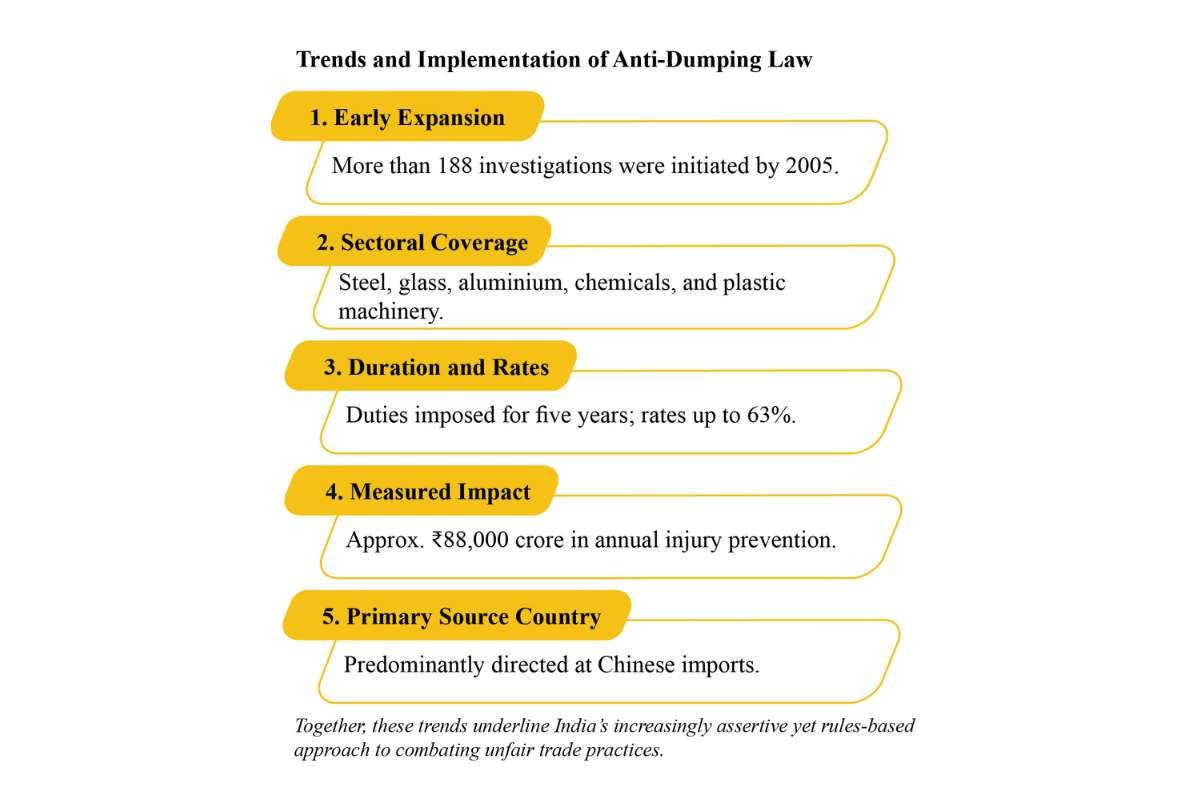
India’s anti-dumping framework functions as a structured trade remedy mechanism consistent with WTO disciplines. Its significance lies in the deliberate use of duties to address sustained price distortions without creating blanket trade barriers. Current practice reflects a clear reliance on evidence-based investigation, application across multiple industrial sectors, and targeted action against import sources that exert persistent competitive pressure on domestic producers.
Anti-dumping measures are no longer applied as isolated responses; they form part of a systematic approach to trade regulation intended to support manufacturing continuity and market balance.
| Aspect | Key Trends |
| Early Expansion | More than 188 investigations were initiated by 2005. |
| Sectoral Coverage | Steel, glass, aluminium, chemicals, and plastic machinery. |
| Duration and Rates | Duties imposed for five years; rates up to 63%. |
| Measured Impact | Approx. ₹88,000 crore in annual injury prevention. |
| Primary Source Country | Predominantly directed at Chinese imports. |
Together, these trends underline India’s increasingly assertive yet rules-based approach to combating unfair trade practices.
Impact of Anti-Dumping Duties on Indian Manufacturers
Anti-dumping duties are a key tool for protecting Indian manufacturers against unfairly priced imports. They aim to preserve domestic production, employment, and market stability while signalling acceptable trade practices to foreign suppliers.
- Anti-dumping duties correct price imbalances that place domestic manufacturers at a competitive disadvantage.
- They neutralise artificially low import prices, restoring market stability and enabling fair competition.
- Domestic producers experience steadier production planning and higher capacity utilisation as sudden price undercutting declines.
- Sustained production supports employment security within manufacturing clusters affected by price volatility.
- Filing for relief requires detailed financial, pricing, and market data, which imposes technical and administrative demands on domestic firms.
- Higher import prices can increase costs for downstream industries, generating resistance from sectors dependent on imported inputs, such as textiles.
- Anti-dumping actions may trigger legal challenges or retaliatory measures under international dispute mechanisms, creating uncertainty.
- These measures act as regulatory signals, clarifying acceptable pricing behaviour and influencing foreign suppliers to adjust market conduct.
These impacts highlight both the benefits and challenges of anti-dumping measures, setting the stage to examine the technical and procedural complexities involved in their enforcement.
Complexities in Enforcing Anti-Dumping Measures
Implementing Indian anti dumping law presents several technical and procedural difficulties. Determining whether imported products qualify as a “like article” requires careful comparison of product characteristics, uses, and quality, while establishing appropriate normal values often involves complex adjustments. These technical assessments can extend investigation timelines. Data limitations further complicate the process, as exporters may provide incomplete information or fail to cooperate, making the accurate calculation of dumping margins challenging.
Legal appeals represent another source of delay. Parties dissatisfied with DGTR findings can approach the Customs, Excise, and Gold (Control) Appellate Tribunal, potentially prolonging resolution and creating uncertainty for domestic producers awaiting relief. Additionally, Indian anti dumping law does not mandate an explicit public interest test before imposing duties, which raises questions about the broader economic and social consequences of such measures.
Collectively, these challenges underscore the need for meticulous investigations and procedural transparency in safeguarding fair trade.
Policy Considerations and Strategic Responses
Effective anti-dumping enforcement depends on careful preparation and strategic coordination. Domestic manufacturers must compile detailed and accurate cost, pricing, and market data to substantiate claims of dumping. Collaboration with trade associations can enhance the credibility of petitions, as collective representation provides a stronger evidentiary basis. Continuous monitoring of international trade flows allows early identification of abnormal price patterns, enabling timely intervention before material injury occurs.
At the international level, active engagement in WTO discussions and dispute settlement processes helps India defend its measures or contest unfair duties imposed by other countries. Together, these practices provide a structured and proactive approach, ensuring that anti-dumping duties are applied efficiently and in a manner consistent with both domestic interests and global trade obligations.
Conclusion
Indian anti dumping laws offer a structured mechanism to counter unfair pricing practices that threaten domestic industries while maintaining adherence to international trade obligations. When applied carefully, these measures help preserve production, employment, and market stability. Looking ahead, combining precise legal enforcement with proactive industry preparedness and ongoing policy assessment will enable Indian manufacturers to manage external pricing pressures effectively and sustain competitiveness in global markets.