




When conversations around the future of India begin, they often circle back to one important question: What kind of leadership is required for the country to grow? Many will say that vision is the most important quality in a leader. While vision is crucial, there’s more to leadership than is essential for long-term success. The qualities that separate good leaders from great leaders are the discipline to execute, the courage to stand alone, and the integrity to stay consistent even when the spotlight is not on you.
Dr. Kiran Bedi is one of the very few leaders who powerfully embody this blend of conviction and action. From becoming India’s first woman IPS officer to serving as the Lieutenant Governor of Puducherry, her career has consistently reflected a belief that authority means little without accountability. She has never viewed leadership as a position of power, but as a responsibility to act.
It is perhaps fitting, then, that as conversations around the future of India gather momentum at platforms like Bharat 2.0 Conclave, leaders across sectors are revisiting the kind of principles that built transformative careers like hers. This March 14 in Mumbai, Kiran Bedi will be joining Bharat 2.0 Conclave as the Honorary Guest, bringing with her reflections shaped by decades of public service and reform.
Before hearing her insights in person, let us look at seven leadership lessons her life continues to teach. These lessons remain relevant for every business leader dealing with change today.
Here are 7 leadership lessons we can learn from the life of the first female IPS officer.
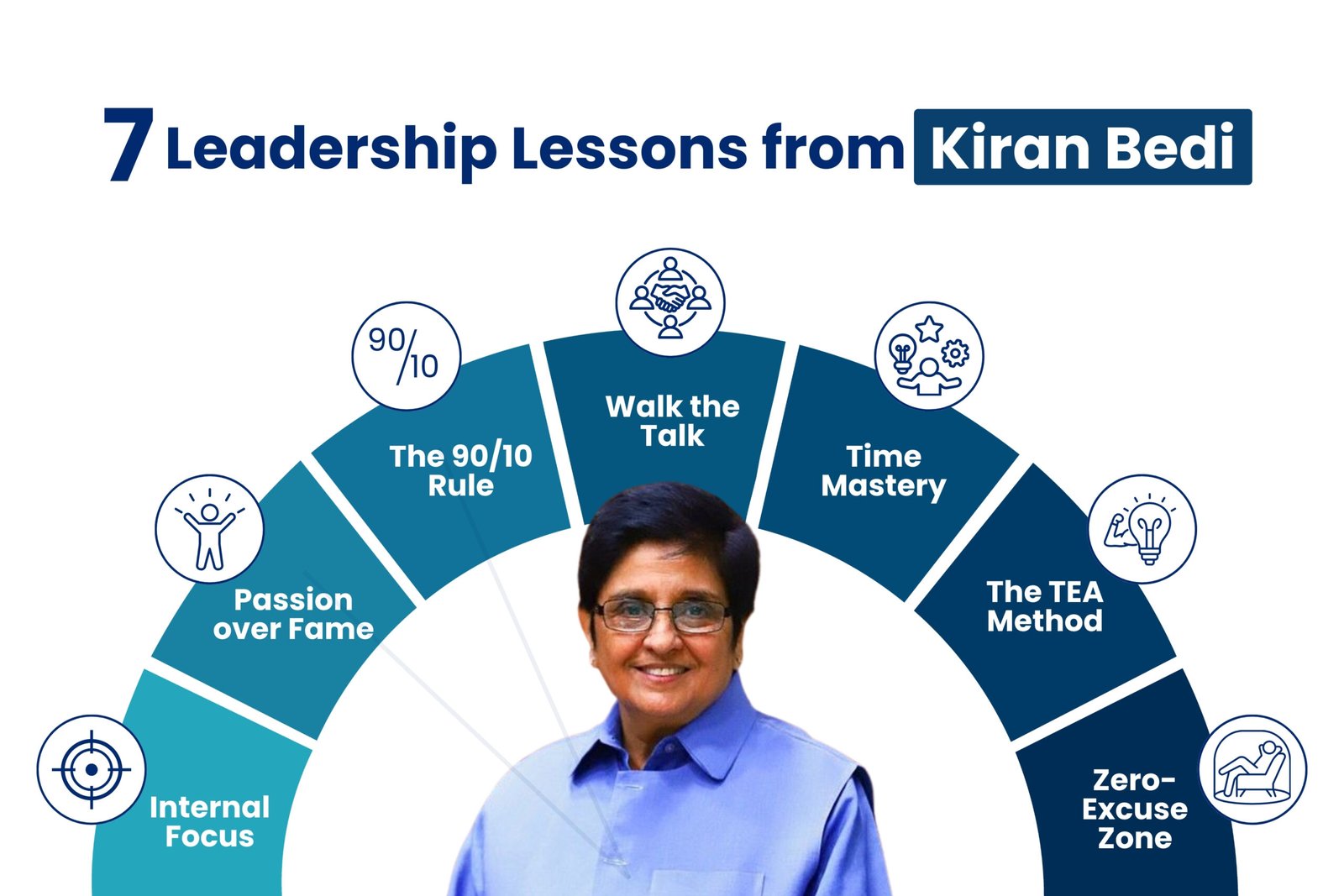
1. Internal Focus of Control
Bedi believes that you must be your own toughest judge. Most people look for a pat on the back from a boss. She says you should look in the mirror instead. Set your own goals. Work with a sense of high quality that does not depend on who is watching.
When you compete only with your own past, you stay in control of your growth. You do not let the world tell you how good you are. You decide that for yourself by raising the bar every single day.
How to implement?
- Audit your self-talk: Every time you fail, catch yourself if you say, “they didn’t help me.” Instead, ask, “What could I have done better?”
- Set “Silent Goals”: Create three targets for your work that nobody else knows about. Achieving them just for yourself builds a private sense of power.
- The Review: At the end of each week, grade your own effort on a scale of 1 to 10. Do not wait for a boss to tell you how you performed.
2. Passion for Your Work
To lead like Bedi, you must love the work more than the fame. She teaches that you should give your best effort without asking, “What will I get for this?” Real joy comes from the act of doing the job well.
If you only work hard to get a prize, your spark will fade when the prizes stop. When you focus on the work itself, you find a deep sense of peace. This makes you a steady leader that others can lean on.
How to implement:
- Find the “Why”: Before starting a task, identify one person who benefits from you doing it well. Focus on that person, not the paycheck.
- Ignore the “Like” button: Practice doing a great job on a project and then staying quiet about it. Let the quality of the work be your reward.
- Deep Work: Set aside one hour where you focus purely on the craft of your task, blocking out all thoughts of fame or promotion.
3. Own Your Choices
Life is not something that just happens to you. Bedi uses a clear split based on the works of Dr Stephen Covey: 90% of your life comes from your own choices. Only 10% is about things you cannot change, like the weather or the past.
When you own your choices, you stop blaming the world for your stress. You realise that you have the power to change your path. This mindset turns a victim into a victor. It gives you the strength to stand tall even when things get hard.
How to implement:
- The 90/10 Rule: When a problem hits, take a piece of paper. List the 10% you cannot change on the left. On the right, list the 90% of things you can control.
- Stop the Blame: For one whole day, commit to not blaming the traffic, the weather, or a coworker for any delay.
- Decision Journal: Write down why you made a big choice. If it goes wrong, look at your logic, not your luck.
4. Walk Your Talk
A leader must be a living example of their words. Bedi showed this when she had the Prime Minister’s car towed for a parking rule. She did not just talk about the law; she followed it. This takes great heart and a firm spine.
If a leader says one thing but does another, the team will lose heart. When you show that the rules apply to everyone, you build a culture of truth. People follow a leader they can trust to be fair.
How to implement:
- The Mirror Test: Before you give an order or a piece of advice, ask yourself: “Am I doing this exact thing right now?”
- Micro-Integrity: Start with small things. If you say you will call at 2:00 PM, call at exactly 2:00 PM.
- Stand Firm: If you see a rule being broken by someone “important,” speak up politely but firmly. Consistency is built in the tough moments.
5. Master Your Time
Bedi learned the value of a second on the tennis court. She treats time as a sacred tool. To her, being a good manager of time is a sign of a disciplined mind. You cannot lead a big team if you cannot lead your own day.
Being on time and staying on task shows that you have a purpose. It keeps you ready for any challenge that comes your way. Discipline is not a cage; it is the path to being free and effective.
How to implement:
- The 5-Minute Rule: Arrive at every meeting five minutes early. This simple habit shows you respect your own time and the time of others.
- Time Blocking: Use a calendar to give every hour a job. Do not just “work”; know exactly what you are working on.
- The “No” List: Identify three things that waste your time each day and cut them out. Being a master of time means saying “no” to distractions.
6. Build Trust through Connection
She leads from the middle of the pack, not from a high throne. She uses a simple tool called TEA: Trust, Empowerment, and Accountability. First, you must trust your team. Then, you give them the power to act.
Finally, you make sure everyone is accountable for the results. This way of working makes everyone feel like they own the mission. It builds a strong bond where every voice is heard, and every hand is busy.
How to implement:
- Use the TEA Method:
- Trust: Give a team member a task and do not check in until the deadline.
- Empowerment: Ask your team, “How would you solve this?” instead of telling them what to do.
- Accountability: Have a short “What went well and what didn’t” meeting every Friday, where everyone is honest.
- Listen More: In your next meeting, try to speak last. Listen to every other voice before you add your own.
7. Rise Above Circumstances
Bedi never accepts excuses. She says you should not blame your tools or a bad situation. Instead, you must invest in yourself until you are better than the problem. She calls this “constructive discontent.”
It means you are never okay with things being “just fine” if they could be great. View life as a climb that goes up. Do not look for an easy way out. Look for a way to make the path better for those who come after you.
How to implement:
- Zero-Excuse Zone: If a tool breaks or a system fails, spend zero minutes complaining. Spend all your time finding a “workaround.”
- Skill Up: Identify the one thing that holds you back most. Spend 20 minutes a day learning that specific skill until it is no longer a problem.
- Constructive Discontent: Once a month, look at a process that works “okay” and find one way to make it 10% faster or better.
Kiran Bedi’s Fearless Rise From IPS Pioneer to National Reformer

Kiran Bedi made history in 1972 as the first woman to join the Indian Police Service (IPS). Her career was marked by a series of bold, first-of-their-kind moves that changed how people viewed the law and its enforcers.
She famously earned the name “Crane Bedi” after her unit towed a Prime Minister’s car for a parking violation, proving that no one is above the law.
As the head of Tihar Jail, one of the world’s largest prisons, she replaced a culture of violence with a “3C model“ (Correction, Compassion, and Clarity). She introduced education, yoga, and meditation (Vipassana) to help inmates restart their lives.
She served the United Nations as a Police Advisor in peacekeeping operations and later took on the political role of Lieutenant Governor of Pondicherry, where she focused on direct communication with citizens and transparent governance.
She founded two major NGOs, Navjyoti India Foundation and India Vision Foundation, which have worked to help underserved children and families affected by imprisonment.
What is She Doing Now?

Today, Kiran Bedi has shifted her focus from active administration to mentoring, writing, and systemic reform. She remains one of India’s most vocal advocates for ethical leadership and environmental responsibility.
In early 2026, she launched the “Kiran Bedi Leadership Learning Program” at CGC University Mohali. This initiative uses real-life simulations to teach students how to make tough decisions in high-pressure jobs.
She is a leading voice for the “Viksit Bharat” (Developed India) 2026 vision, calling for “proactive and visible governance” where citizens play a direct role in how the country is run.
She has become a key advocate for air quality reform. Recently, she proposed a “National Clean Air Data Centre” and institutional changes to tackle pollution with the same discipline she used in policing.
She continues to write columns for major newspapers, like The Hindustan Times, focusing on the need for “moral authority” in leadership. She also manages a YouTube channel called “Demonstrative learning” to mentor youth online.
And she will be joining us as an honorary guest for Bharat 2.0 conclave on March 14th 2026.
Conclusion:
Kiran Bedi is what we envision the new India to be. There will be no new India without Kiran Bedi’s reforms. Her life reminds us that sometimes leadership isn’t handed to you; you must grab it. These 7 lessons on leadership are necessary for every leader to make.
To be a good leader, you need to rise above your circumstances, own your choices, and master your time. These are essential leadership skills that surpass all sectors and industries.
As we get ourselves ready to welcome Bedi at the event, we would like to invite you all to join us at Bharat 2.0 conclave on the 14th of March.