

Modern organizations are surrounded by technology yet starved of clarity. Despite unprecedented access to digital tools, AI platforms, and transformation budgets, many enterprises struggle to convert technology investments into sustained business advantage. Strategy stalls in execution, innovation drowns in hype, and leadership gaps emerge at the exact moment when experience is most needed. The problem is rarely a lack of ambition or funding; it is the absence of seasoned, context-aware technology leadership that can bridge business vision with operational reality. As markets accelerate and complexity compounds, companies are left searching for a leadership model that delivers direction, ownership, and outcomes, not just advice.
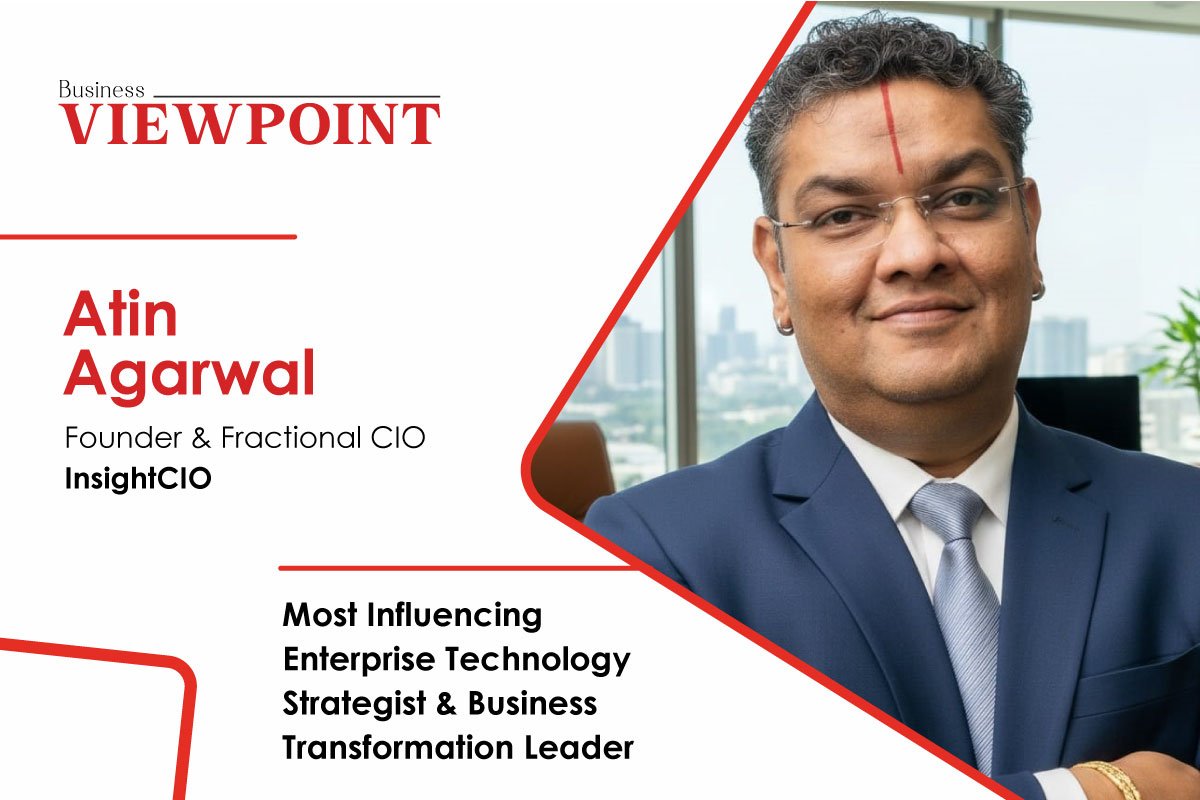
That gap is precisely where Atin Agarwal, Founder and Fractional CIO at InsightCIO, has built his influence. With decades of experience leading large-scale technology organizations, Agarwal redefined how senior technology leadership can be delivered—flexible in structure, uncompromising in accountability, and deeply aligned with business strategy.
Redefining Influence in the Modern Era
To understand Atin Agarwal’s impact, one must first understand his philosophy on power and presence. In an era where “influencer” is often a label attached to social media metrics, Atin offers a more profound, gravitational definition of the term suitable for the C-suite.
“True influence is not about authority—it is about shaping thinking and enabling action, even when you’re not in the room.”
For Agarwal, influence has decoupled itself from the traditional markers of hierarchy and designation. He argues that in a business world defined by rapid disruption, authority alone is brittle. True resilience and agility come from influence built on credibility, trust, and a steadfast consistency of intent.
“Leaders who are truly influential today are those who can simplify complexity,” Atin notes. He describes the modern leader’s mandate as the ability to provide clarity during periods of deep ambiguity and to inspire confidence across all levels of an organization. This is not a top-down exercise but a pervasive energy that permeates the corporate culture.
His experience suggests that influence is earned, not appointed. It is the byproduct of people believing that a leader understands both the harsh business realities and the delicate human dynamics at play. Crucially, Atin Agarwal believes influence extends beyond organizational boundaries. It is measured by how ideas travel, how mentees grow into leaders themselves, and how decisions made today continue to create value years down the line. “Influence, ultimately, is impact that endures even after you step away,” he asserts. This perspective sets the stage for his entire career trajectory: a pursuit of enduring impact over ephemeral status.
The Pivot: From Scale to Amplified Impact
Every visionary leader faces a crossroads, a moment where the comfortable path of corporate ascension no longer aligns with their internal compass. For Atin, the transition from a traditional Senior Technology Leader to launching his own venture was not sparked by a sudden epiphany, but by a gradual, observant realization of a market gap.
“The real click was realising that my next chapter was not about scale or title, but about amplifying impact.”
Atin Agarwal recalls that there wasn’t a single dramatic flash of lightning. Instead, it was the recognition of recurring patterns across the organizations he observed. He saw businesses ambitious, well-funded, and eager, struggling not because of a lack of drive, but due to the absence of seasoned, contextual technology leadership at critical junctures. They were ships with powerful engines but no seasoned captain to navigate the technological reefs.
“Having spent decades building and leading large technology organizations, I recognized that my experience could create far greater value if delivered with flexibility,” he explains. He realized that in the traditional full-time model, his impact was confined to one vessel. By breaking free of those structures, he could multiply his impact across a fleet of growing enterprises. This understanding that expertise could be a shared resource rather than a hoarded asset made building InsightCIO the natural, evolutionary next step.
The Evolution of the CIO: Technology as Strategy

The role of the Chief Information Officer (CIO) has perhaps undergone more change in the last fifteen years than any other C-suite position. Atin Agarwal has lived this evolution, moving from the server room to the strategy room.
“Technology is no longer a support function; it is the starting point of business strategy.”
Reflecting on the earlier stages of his career, Atin notes that technology leadership was largely a game of defense: maintaining stability, ensuring cost efficiency, and guaranteeing delivery. The CIO was the custodian of infrastructure. However, as the digital economy matured, it became clear that technology was no longer just the rails the business ran on; it was the engine of growth, competitiveness, and resilience.
“My role evolved from managing systems to shaping outcomes,” he says. This shift required a fundamental change in mindset. Agarwal began working lock-step with CEOs, boards, and business unit leaders to define operating models, map customer journeys, and craft market strategies. In his view, a modern Senior Technology Leader must think like a business strategist first and a technologist second. They must possess a deep understanding of revenue streams, risk mitigation, talent dynamics, and customer behavior, using technology as the primary lever to move these metrics.
Adoption vs. Advantage: The Integration Imperative
In a market flooded with SaaS tools, AI hype, and digital platforms, many leaders fall into the trap of confusing technology adoption with digital transformation. Atin Agarwal draws a sharp line between the two.
“Technology creates advantage only when it is deeply integrated into business thinking, not when it is treated as a standalone initiative.”
The differentiator, according to Atin, is intent. Leaders who merely adopt technology are often chasing trends, focusing on the “what” rather than the “why.” They install tools hoping for magic. In contrast, leaders who create sustained business advantage focus on integration and outcomes. They ensure that technology is aligned with the core strategy, embedded deeply into processes, and most importantly, embraced by the people who must use it.
Atin Agarwal emphasizes the necessity of long-term thinking. “Sustainable advantage is built through platforms, governance, and capability development, not quick wins,” he warns. The leaders who understand this are playing the long game. They are not looking for a quarterly boost from a new gadget; they are building foundations that endure market cycles.
The Fractional CIO Model: Experience with Accountability

This philosophy of strategic integration brings us to the core of Atin’s current mission with InsightCIO: The Fractional CIO model. To the uninitiated, this might sound like high-level consulting, but Atin is quick to distinguish the two.
“Fractional leadership delivers experience with accountability, not advice without ownership.”
The Fractional CIO model was born to solve a structural gap in the market. Many organizations, particularly mid-sized enterprises and high-growth startups, have a desperate need for senior, strategic technology leadership. However, they may not need or cannot afford a full-time, veteran CIO with a C-suite compensation package.
“Traditional consulting often stops at recommendations,” he points out. Consultants advise, but they rarely execute. Full-time roles, conversely, can be rigid and expensive. The Fractional CIO bridges this divide. They bring proven leadership and, crucially, execution ownership. They don’t just write the roadmap; they drive the car.
Atin Agarwal notes that this model is “mainly meant for SMBs and organizations with low budgets but with the aspiration to grow faster and become leaders in their segment.” It provides these companies with a heavy-hitting strategist who can sit at the decision-making table, offer clarity, and drive execution without the overhead of a permanent executive structure.
Pragmatic Innovation: Escaping the Hype Cycle
“Innovation” is a buzzword that often loses its meaning in corporate slide decks. Atin, however, approaches innovation with the grounded realism of someone who has seen projects both soar and crash.
“Innovation fails when it chases tools instead of solving real business problems.”
His approach is refreshing in its pragmatism. He believes innovation must start with the business context, not a fascination with the latest tech. “Not every organization needs disruption,” he states candidly. “Many need focused, incremental innovation aligned to outcomes.”
For Atin Agarwal, practical innovation is a disciplined exercise. It requires clear ownership, measurable goals, simplified architectures, and robust governance. But beyond the mechanics, he highlights the cultural necessity: “Most importantly, it needs a culture where people feel safe to experiment, question assumptions, and learn from failure.” Without psychological safety, innovation remains a theoretical exercise.
He illustrates this with a pivotal moment from his career where technology became a catalyst for a fundamental shift.
“Courageous technology decisions, when aligned with business vision, can redefine organisational trajectories.”
He recounts a critical juncture in a previous organization where the easy choice was to apply incremental fixes to an aging system. Instead, they chose to redesign the digital core entirely. It was a high-risk decision involving significant change management. However, that courage paid off. The new core enabled faster product launches, data-driven decision-making, and a vastly improved customer experience. “More importantly, it shifted the mindset from reactive operations to proactive growth,” Atin reflects. This reinforced his belief that when technology decisions are bold and aligned with vision, they change the destiny of the business.
Lessons from the Trenches: People Over Plans
With a career spanning complex and high-pressure environments, Agarwal has gathered lessons that cannot be taught in business school. These are lessons forged in the fires of real-world execution.
“People matter more than plans, and timing matters as much as strategy.”
Experience teaches humility, Agarwal says. He has learned that the most brilliant strategies will fail if the people tasked with executing them do not believe in the mission. “Execution happens through trust, not instruction,” he says. This is a profound insight for a technologist that the code is secondary to the culture.
He also emphasizes resilience. In the real world, things go wrong: servers crash, markets shift, pandemics hit. “Leadership is about staying calm, learning fast, and responding thoughtfully rather than reactively,” he says. These are the stripes earned only through time and pressure.
This people-centric philosophy extends to his advice for other leaders regarding their own teams and legacies.
Authoring a Legacy: Sharing the Unspoken Truths
Recently, Atin added “Author” to his repertoire. For a man focused on execution, writing a book was a deliberate act of giving back.
“The book is a reflection of lessons learned when things didn’t go as planned.”
Atin Agarwal felt a responsibility to document the insights that are rarely found in formal education. “Many leaders struggle not due to lack of intelligence, but due to lack of perspective,” he observes. By capturing his experiences, particularly the failures and the messy realities, he aims to offer a guide for navigating ambiguity.
He identifies a specific gap in current leadership thinking that he hopes to address.
“Leadership is often portrayed as linear, but reality is far messier—and that truth needs to be acknowledged.”
Most business literature presents a sanitized version of success: distinct steps leading to a guaranteed outcome. Agarwal’s book challenges this by emphasizing integrated thinking, where business, technology, and human factors are inextricably linked. He opens an honest dialogue around failure, trade-offs, and uncertainty, aiming to prepare leaders for the complexity they will actually face, not the idealized version they read about.
“If the book helps leaders think more clearly and act more decisively, it has achieved its purpose.”
His aspiration for the book is modest yet profound: to serve as a reference for leaders navigating transformation. If it helps even a small group make better decisions or build stronger teams, Agarwal considers the endeavor a success.
Targeting the Ambition Gap

Looking forward, Agarwal is clear about who InsightCIO is designed to serve.
“The greatest value is created where ambition meets complexity.”
His target demographic includes mid-sized enterprises, growth-stage companies, and family-owned businesses in transition. These are organizations that have the ambition to scale but are encountering the complexity that comes with growth. Industries like telecom, manufacturing, FMCG, and services, where scale and transformation intersect, are where he sees the strongest impact. These organizations benefit most from the “strategic depth, speed, and pragmatism” that the Fractional CIO model provides.
Success, Balance, and the Future
As he looks toward 2030, Atin’s metrics for success have evolved.
“Success today is relevance, purpose, and impact—not accumulation.”
Gone are the days when success was defined solely by milestones, titles, and the scale of the budget managed. Today, Atin finds fulfillment in continuity, knowing that the systems, teams, and leaders he has touched are stronger because of his involvement. His financial journey reflects this shift as well.
The Road to 2030
What lies ahead for Atin Agarwal?
“The next decade is about combining wisdom with agility to create meaningful impact.”
By 2030, he envisions himself as a trusted advisor and a builder of a strong Fractional CIO ecosystem. He aims to continue advising, mentoring, writing, and scaling impact. But on a personal level, his goals remain grounded: “To remain curious, grounded, and purposeful, contributing meaningfully while continuing to learn and evolve.”
Atin Agarwal’s profile is not just that of a successful technologist; it is a blueprint for the modern leader. He demonstrates that one can be technical yet human, strategic yet practical, and authoritative yet humble. In a world of noise, he offers the quiet confidence of competence, proving that the most powerful technology of all is clear, human-centric leadership.