


Key Takeaways:
- Major space milestone: The EOS-05 launch marks India’s first imaging satellite from geosynchronous orbit and, at 2,367 kg, its heaviest Earth-observation satellite so far.
- Better real-time monitoring: Its advanced imaging capabilities and high-frequency observation potential could improve monitoring of weather, disasters, agriculture, and natural resources.
- Private-sector opportunity: The mission could accelerate demand for Indian companies working in satellite technology, geospatial analytics, AI-driven Earth observation, and space-based applications.
EOS-05 launch marks major milestone for India’s earth observation programme
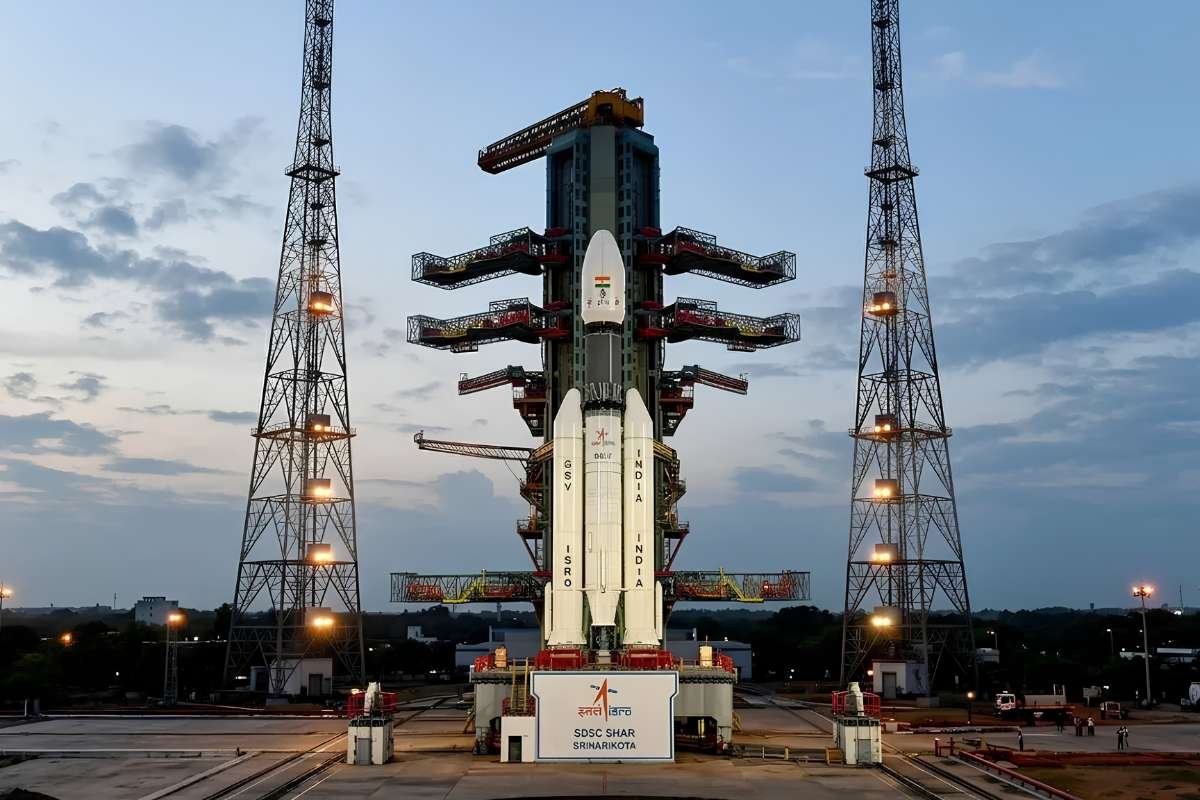
The Indian Space Research Organisation (ISRO) successfully completed the EOS-05 launch, placing India’s first dedicated imaging satellite from geosynchronous orbit into space on September 4, 2026. The satellite was launched aboard the GSLV-F17 rocket from the second launch pad at the Satish Dhawan Space Centre in Sriharikota.
The launch took place at 2:55 am IST following a 27-hour countdown that began on Wednesday evening. About 18 minutes after liftoff, the rocket successfully placed EOS-05 into its intended sub-geosynchronous transfer orbit (Sub-GTO).
With a mass of 2,367 kg, EOS-05 is the heaviest Earth observation satellite launched by India so far. The mission also marks the 19th flight of the Geosynchronous Satellite Launch Vehicle (GSLV).
The successful EOS-05 launch highlights ISRO’s growing ability to launch heavier and more advanced satellites into high orbits. ISRO Chairman V Narayanan said the launch vehicle’s performance had been improved through structural-mass optimisation and propulsion-system upgrades, allowing it to carry the heavier spacecraft.
The mission is also significant because it demonstrates progress in India’s ability to execute complex Earth-observation missions after the unsuccessful EOS-03 mission in 2021.
EOS-05 strengthens high-frequency earth observation
EOS-05 has been developed with advanced imaging capabilities covering visible, infrared, multispectral and hyperspectral bands. Its geosynchronous positioning is expected to allow more persistent observation of large geographical areas compared with satellites that depend on periodic revisits.
This capability could be particularly useful for monitoring events that develop rapidly. Applications may include tracking severe weather systems, floods, forest fires and agricultural conditions, along with monitoring natural resources and India’s land and maritime areas.
Frequent satellite observations can provide agencies with updated information when conditions change quickly. This could support disaster management, weather monitoring, agriculture, environmental assessment and other activities that depend on timely Earth observation data.
The satellite also adds to India’s broader Earth-observation infrastructure. As satellite imagery becomes increasingly important for planning and decision-making, the ability to collect detailed and frequent observations can support both public-sector programmes and commercial geospatial applications.
The mission’s importance therefore extends beyond the successful launch itself. EOS-05 represents a move toward more specialised satellite capabilities designed to deliver useful information for a wide range of operational requirements.
Private space industry could benefit from new data
The successful EOS-05 launch could also create new opportunities for India’s growing private space and geospatial technology ecosystem.
The value of an Earth-observation satellite increasingly depends not only on collecting imagery but also on how effectively that data is processed and converted into actionable information. Private companies working in geospatial analytics, artificial intelligence, satellite applications and data services could play an important role in turning EOS-05 observations into practical solutions.
Potential commercial applications could span agriculture, infrastructure planning, disaster response, environmental monitoring, insurance and resource management. Greater access to high-quality Earth-observation data could also encourage the development of new services built around satellite imagery and analytics.
The mission comes as India continues to expand private-sector participation in its space economy. ISRO’s technical capabilities, combined with private industry’s expertise in data processing and commercial applications, could strengthen the country’s position in the global space and geospatial markets.
EOS-05 is therefore both a technological achievement and a potential foundation for wider use of space-based intelligence. Its successful deployment demonstrates India’s progress in handling heavier and more sophisticated Earth-observation missions while opening another chapter in the country’s expanding space ecosystem.