



A degree alone can no longer guarantee a successful career.
Students need practical skills, industry exposure, research experience, confidence, and knowledge of technologies that are reshaping the workplace. When education fails to keep pace, graduates may enter the workforce with outdated knowledge and limited exposure to real-world challenges. Universities, therefore, face a bigger responsibility: to keep learning relevant while strengthening research, innovation, quality, and employability. Meeting this responsibility requires academic leaders who can turn changing industry needs into meaningful educational opportunities.
At the forefront of this effort is Prof. (Dr.) Manish Bhalla, Vice Chancellor of D Y Patil International University (DYPIU), Akurdi, Pune. With more than three decades of experience in teaching, research, academic administration, and quality assurance, he is helping shape DYPIU into a future-ready institution.
His leadership focuses on connecting education with industry, strengthening research and innovation, and preparing students for emerging fields such as Artificial Intelligence, Cybersecurity, Semiconductor Engineering, Quantum Computing, Biology, Medicinal Chemistry, etc..
Through collaborations with IBM and Dassault Systèmes, Keynes Semicon, Tech MahindraTata Technology, Atals Copco, etc., stronger industry-linked curricula, research initiatives, entrepreneurship support, and rigorous quality systems, Dr. Manish Bhalla is working to close the gap between what students learn and what the world expects from them.
His journey reflects a simple belief: education should not prepare students only for the jobs available today, but for the opportunities that are still taking shape.
From classroom experience to building a future-ready university
Dr. Manish Bhalla’s journey has been shaped by more than 30 years of experience across classrooms, laboratories, and university administration. He has worked as a professor of chemistry, researcher, Registrar, and head of Internal Quality Assurance, with each role adding a different perspective to his understanding of education. Teaching taught him to listen to students and appreciate their questions. Research taught him patience, curiosity, and the importance of finding answers through continuous learning. Administration taught him that meaningful change requires strong systems and consistent effort.
When he joined D Y Patil International University, the institution was still in its early years. Established in 2018, its young age offered him an opportunity to contribute to an institution that could grow and evolve with changing expectations. Instead of following established patterns simply because they were familiar, he focused on creating an environment where academic processes could keep improving with time.
A key part of this approach has been making quality assurance more meaningful. Rather than treating it as a formal requirement, he sees feedback, academic reviews, and conversations with students, faculty, alumni, and industry as important ways to understand what is working and where improvement is needed. This has shaped his belief that institutional progress comes from listening carefully, identifying gaps, and acting on what is learned.
Beyond systems and academic responsibilities, his work is driven by the impact education can have on individual lives. He is particularly inspired by students who come from smaller towns or are the first in their families to pursue higher education. Helping them gain confidence, recognize their potential, and believe that they can compete on a larger stage remains one of the most meaningful parts of his journey.
Preparing students for real-world careers
DYPIU’s approach to academic excellence is based on four key areas: relevant education, industry exposure, interdisciplinary learning, and strong quality systems. Its programmes, from Bioengineering to Journalism and Mass Communication, are designed to help students gain practical knowledge and skills that they can use in their careers.
Industry exposure is an important part of learning at DYPIU. Its partnership with IBM India brings Artificial Intelligence, Machine Learning, and Cybersecurity into the B.Tech. Computer Science curriculum. Its collaboration with Dassault Systèmes is also helping develop a Digital Engineering and Digital Manufacturing Experience Centre with facilities for product innovation, intelligent production, virtual twins, and simulation.
Students are also encouraged to learn across disciplines through schools covering Engineering, Management, Design, Biosciences, Media, and Liberal Arts. The Centre for Innovation, Incubation & Entrepreneurship helps students turn ideas into projects and ventures.
Quality remains central through feedback from students, alumni, recruiters, and academic reviews. DYPIU’s recognition among the Top 50 State Private Universities in India by Outlook reflects its steady progress.
Getting ready for tech-driven futures
Higher education is changing quickly, and universities that continue to follow outdated models risk leaving students unprepared for the workplace. A degree is no longer enough on its own. Employers increasingly look for graduates who can apply knowledge, solve problems, communicate confidently, and adapt to changing situations.
Dr. Manish Bhalla believes universities must respond to these changes by reshaping what and how they teach.
His approach at DYPIU focuses on four key areas:
- From degrees to practical ability: Students need opportunities to demonstrate what they can build, design, solve, and communicate, rather than relying only on academic qualifications.
- Emerging technologies in education: Fields such as Artificial Intelligence, Semiconductor Engineering, and Quantum Computing are being introduced through programmes including B.Tech in Semiconductor Engineering and M.Tech in Quantum Computing, giving students early exposure to future-focused areas.
- Stronger industry involvement: Collaborations with IBM and Dassault Systèmes help bring industry knowledge, tools, and practical learning into the curriculum instead of limiting industry interaction to occasional visits or placement activities.
- Preparing students for global opportunities: Students need strong communication skills, broader exposure, and an understanding of different cultures to compete and collaborate in an increasingly connected job market.
This approach reflects a larger belief that education must remain closely connected to changing industries and real student needs. For Dr. Manish Bhalla, a university’s curriculum cannot remain fixed while the world around it changes. It must continue to grow, adapt, and prepare students for careers that are still taking shape.
From classroom concepts to real-world solutions
Research excellence at a young university cannot be built simply by following the metrics of older institutions. At DYPIU, the focus has been on creating the right infrastructure, opportunities, and support systems first, with the belief that strong research outcomes grow from sustained investment.
This approach is reflected in three key areas:
- Applied Research: DYPIU integrates practical research opportunities into programmes such as Bioengineering, Medical Biotechnology, and Medicinal Chemistry, allowing students to work on problems with real-world value rather than focusing only on theory.
- Innovation and Entrepreneurship: Through the Centre for Innovation, Incubation & Entrepreneurship, students can develop classroom ideas into early-stage ventures while continuing their studies. This allows them to explore entrepreneurship without having to choose between academics and building a business.
- Advanced Research Infrastructure: The Digital Engineering and Digital Manufacturing Experience Centre, established in collaboration with Dassault Systèmes, gives students access to technologies such as generative design, multi-physics simulation, and virtual twins, bringing advanced industry tools into the academic environment.
Industry collaboration is another important part of DYPIU’s approach. These partnerships are designed to create continued academic and practical value rather than remain limited to one-time announcements.
Key collaborations include:
- IBM: Supporting AI, Machine Learning, and Cybersecurity & Forensics programmes through industry-aligned curriculum and technology exposure.
- Quadrogen Power Systems, Canada: Supporting collaboration in clean technology.
- Aryabhatta Knowledge University: Supporting research collaboration in areas including nanotechnology and stem cell science.
For Dr. Manish, the true measure of research and innovation goes beyond publications or patents. The greater goal is to ensure that DYPIU graduates can apply what they learn to solve real problems and create meaningful value in their careers.
Career support that starts on day one
For Dr. Manish Bhalla, student success is one of the clearest measures of effective education. A programme may look strong on paper, but its true value lies in helping students connect their learning with real careers and opportunities. DYPIU therefore stays connected with students, alumni, recruiters, and industry throughout their academic journey.
Its Corporate Relations and Placement Cell introduces internships, industry exposure, and skill development from the early stages of learning. The university also focuses on communication skills, helping students confidently present their abilities alongside their technical knowledge.
Feedback is another key part of this approach. Through the Internal Quality Assurance Cell, inputs from students, alumni, and recruiters help identify gaps and improve curricula.
DYPIU also recognizes that success takes different forms. Some students enter leading companies, others pursue higher education, while some choose entrepreneurship through the Centre for Innovation, Incubation & Entrepreneurship. By supporting these paths, Dr. Manish keeps students and their individual goals at the heart of academic success.
Smarter workflows for smarter decision-making
Together, these AI tools help Dr. Manish Bhalla work efficiently, make informed decisions, strengthen academic planning, and improve communication while retaining human judgment.
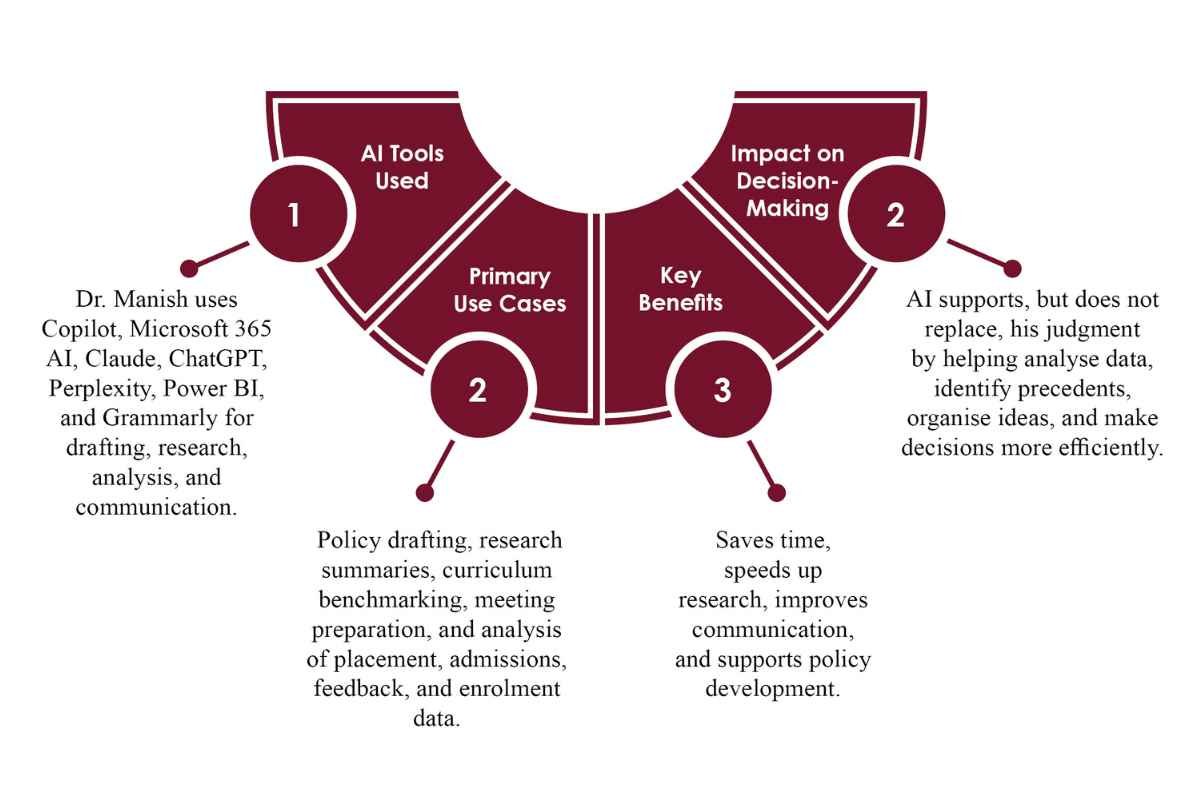
- AI Tools Used: Dr. Manish uses Copilot, Microsoft 365 AI, Claude, ChatGPT, Perplexity, Power BI, and Grammarly for drafting, research, analysis, and communication.
- Primary Use Cases: Policy drafting, research summaries, curriculum benchmarking, meeting preparation, and analysis of placement, admissions, feedback, and enrolment data.
- Key Benefits: Saves time, speeds up research, improves communication, and supports policy development.
- Impact on Decision-Making: AI supports, but does not replace, his judgment by helping analyse data, identify precedents, organise ideas, and make decisions more efficiently.
Achievements, milestones, and measurable impact
DYPIU’s growth is reflected in several measurable developments across academics, infrastructure, industry partnerships, placements, and research:
- Academic Recognition: Recognized among the Top 50 State Private Universities in India by Outlook, a notable achievement for an institution established in 2018.
- Infrastructure Development: Expanded its campus with a new academic floor and dedicated laboratories for engineering, design, and biosciences.
- Industry Partnerships: Collaborates with IBM India on B.Tech programmes in AI & ML and Cybersecurity & Forensics, offering industry exposure and certification pathways.
- Digital Manufacturing: Signed an MoU with Dassault Systèmes to establish a Digital Engineering and Digital Manufacturing Experience Centre focused on product innovation, intelligent production, virtual twins, and simulation.
- Placement Growth: Built recruiter connections across IT, technology, consulting, manufacturing, and design, with growing participation and opportunities across sectors.
- Research Expansion: Strengthening postgraduate and doctoral pathways in Quantum Computing, Medical Biotechnology, Medicinal Chemistry, and Computational Mathematics.
These developments reflect DYPIU’s steady effort to build a stronger academic, industry, and research ecosystem while maintaining a focus on measurable and sustainable growth.
Turning quality assurance into a driver of academic improvement
To strengthen academic excellence, Prof. (Dr.) Manish Bhalla focused on turning quality assurance into a continuous process of listening, learning, and improvement:
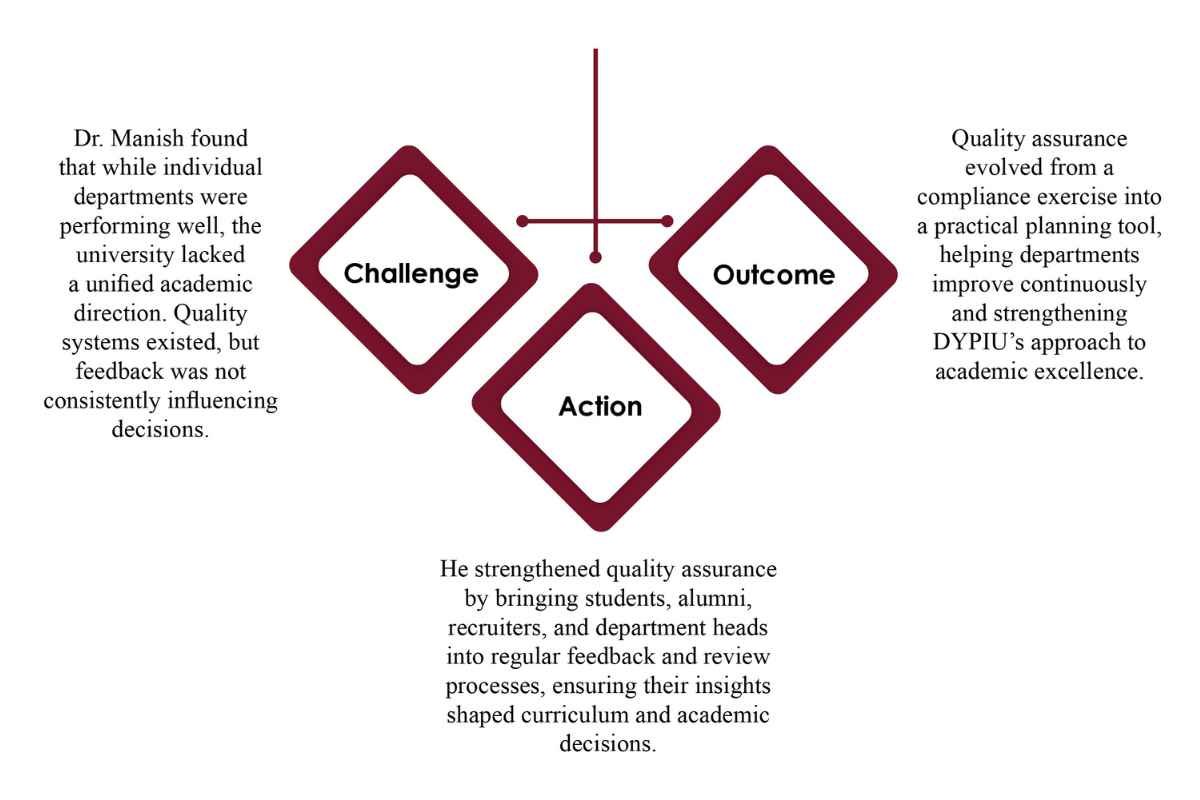
- Challenge: Dr. Manish Bhalla found that while individual departments were performing well, the university lacked a unified academic direction. Quality systems existed, but feedback was not consistently influencing decisions.
- Action: He strengthened quality assurance by bringing students, alumni, recruiters, and department heads into regular feedback and review processes, ensuring their insights shaped curriculum and academic decisions.
- Outcome: Quality assurance evolved from a compliance exercise into a practical planning tool, helping departments improve continuously and strengthening DYPIU’s approach to academic excellence.
Future vision
Looking ahead, Dr. Manish Bhalla is focused on taking DYPIU into its next phase of growth by strengthening industry partnerships with organisations such as IBM and Dassault Systèmes, giving students greater exposure to current tools and technologies. He also aims to expand international academic partnerships, joint research, and student and faculty exchanges while supporting organic growth through collaborations and Centres of Excellence.
Alongside this, he is focused on strengthening the university’s physical and digital infrastructure to support growing student needs. Sustainability and Industry 5.0 will also become a stronger part of engineering and design education, helping students understand the importance of human-centred and sustainable solutions.
At the heart of these priorities is quality assurance. Dr. Manish believes that every initiative must have strong systems, measurable progress, and real value for students. For him, meaningful growth is about building an institution that consistently delivers quality education and creates opportunities for the future.
Dr. Manish’s message for aspiring educators and academic leaders
If I could offer one piece of advice to those beginning their journey in academic leadership, it would be to focus on building strong foundations rather than leading through announcements. New programmes and partnerships may attract attention, but lasting progress comes from strong quality systems, honest feedback, and clear data that continue to deliver results long after the announcement is forgotten.
I would also encourage academic leaders to step outside their own areas of expertise. My background is in chemistry and research administration, yet some of my most valuable decisions as Vice Chancellor have come from listening to colleagues in Design, Journalism, Management, and other disciplines. Good academic leadership requires the willingness to learn from fields beyond one’s own.
Student and recruiter feedback should also be treated as valuable information. Leaders must be willing to listen to difficult feedback about their curriculum and use it to improve rather than defend existing practices.
Finally, I would encourage leaders to be patient. Institutions take time to grow, and some of the work being done today may benefit students who have not yet entered the university. Academic leadership is about building something that continues to create value for future generations.
Prof. (Dr.) Manish Bhalla
Vice Chancellor, D. Y. Patil International University (DYPIU)

Success code
For Dr. Manish Bhalla, lasting success begins with building strong systems before seeking recognition. His philosophy is simple: focus on substance first and let reputation follow. Rankings, awards, and headlines are outcomes of strong quality systems, honest feedback, academic discipline, and continuous improvement. True excellence comes from strengthening an institution from within rather than chasing recognition. This principle has guided his academic leadership journey and continues to shape DYPIU. His belief remains clear: build something meaningful, strengthen its foundation, and let the results speak for themselves.