


Key Points:
- India AI Impact Summit in New Delhi, drawing global leaders and tech executives.
- Modi highlights India’s digital infrastructure and talent as advantages in the global AI race.
- Major firms expand AI presence in India, though analysts warn of research gaps.
India on Monday opens the India AI Impact Summit in New Delhi, drawing world leaders and tech executives as Prime Minister Narendra Modi seeks to position the country as a key player in developing and deploying advanced artificial intelligence.
Global Leaders and Tech Chiefs Converge in New Delhi
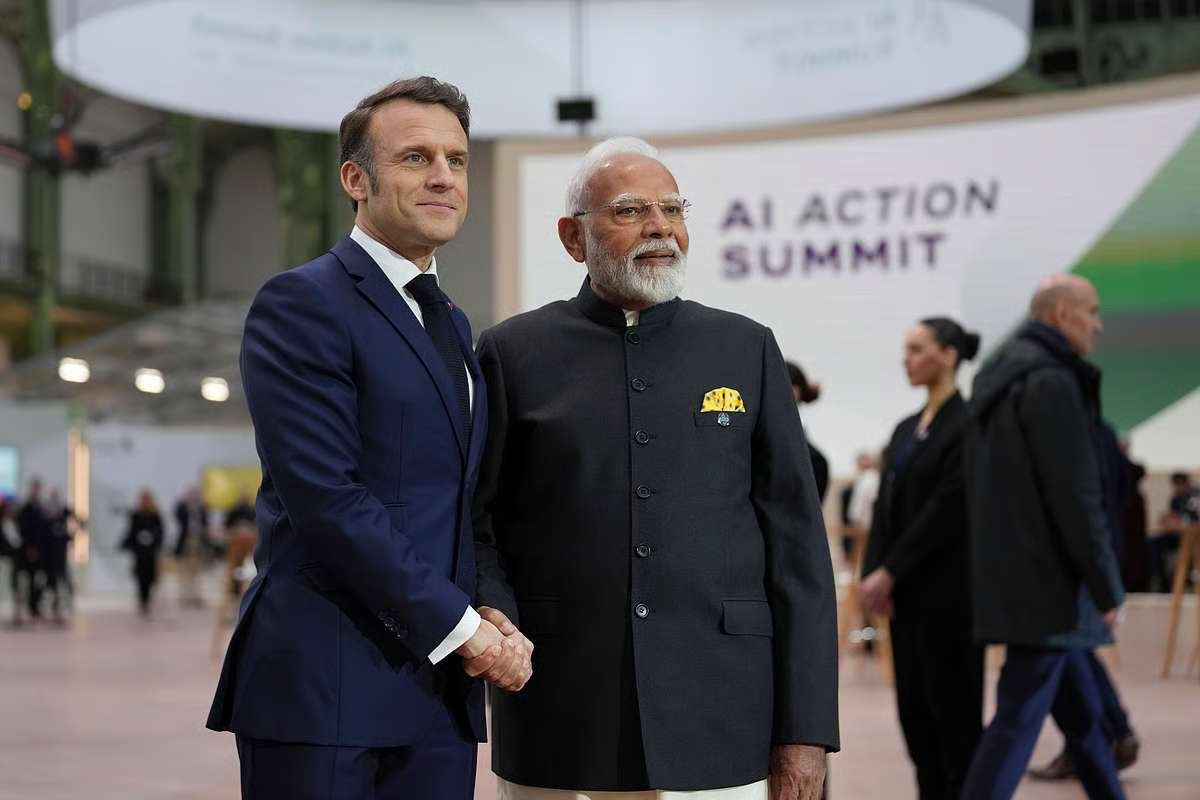
India kicks off one of the world’s largest artificial intelligence gatherings Monday, hosting heads of state, technology executives, startup founders, and investors for the India AI Impact Summit in New Delhi.
The three-day event comes as governments and companies race to build powerful AI systems that could reshape economies, security, and daily life. Organizers say the summit could be the biggest concentration of AI leaders held to date.
Among those expected are executives from major U.S. technology firms, leading AI researchers, and policymakers from Europe, Asia, and the Global South. French President Emmanuel Macron is scheduled to deliver the keynote address during the summit’s final two days, followed by remarks from Modi.
Modi Highlights India’s Scale, Talent, and Digital Infrastructure
For Modi, the India AI Impact Summit is an opportunity to argue that India’s scale and engineering talent give it an edge in the next phase of the global AI race.
India has built vast digital public infrastructure over the past decade, including a biometric identification system covering more than one billion people and real-time payment platforms used by hundreds of millions daily. Officials say those systems create large, diverse data sets that can support AI development across health care, education, and public services
“By overlaying AI on digital identity, payments, and governance, India is trying to compress decades of development into years,” said Abhishek Singh, additional secretary at the Ministry of Electronics and Information Technology. “What gets built for India will not stay only in India.”
India has already begun exporting elements of its digital model. An open-source identity platform inspired by its biometric system is being adopted in countries including the Philippines, Morocco, and Uganda, according to government officials.
In global AI competitiveness, India ranks third, behind the United States and China, according to Stanford University’s Institute for Human-Centered AI.
Investment Grows as Analysts Warn of Research Gaps
Major technology firms are expanding their presence in India, betting on its fast-growing market and large developer base. OpenAI and Anthropic are setting up local operations, while Google and Meta are expanding data centers to support the rising demand for AI services.
NVIDIA, facing U.S. export restrictions on advanced chips to China, has described India as a strategic growth market, though its chief executive withdrew from the summit at the last minute, citing unforeseen circumstances.
Despite the momentum, analysts caution that years of underinvestment in research and development could slow India’s progress. Aakrit Vaish, founder of AI-focused fund Activate, said India must strengthen its research ecosystem to avoid becoming “just a testing lab for Silicon Valley’s algorithms.”
Several India-focused models will debut during the summit. Government-backed BharatGen plans to unveil Param2, a seventeen-billion-parameter model supporting twenty-two Indian languages. Startup Sarvam AI is expected to introduce a larger, voice-first model aimed at affordability.
“Our model is designed to accelerate adoption in governance, education, health care, and farming,” said Rishi Bal, BharatGen’s chief executive. “In much of the developing world, cost is not an afterthought.”
Himanshu Tyagi, co-founder of Sentient AI, said India could still make up ground by focusing on advanced reasoning for science and robotics, where future systems will rely on data beyond the open internet.
Explore Business Viewpoint Magazine for the most up-to-date insights.