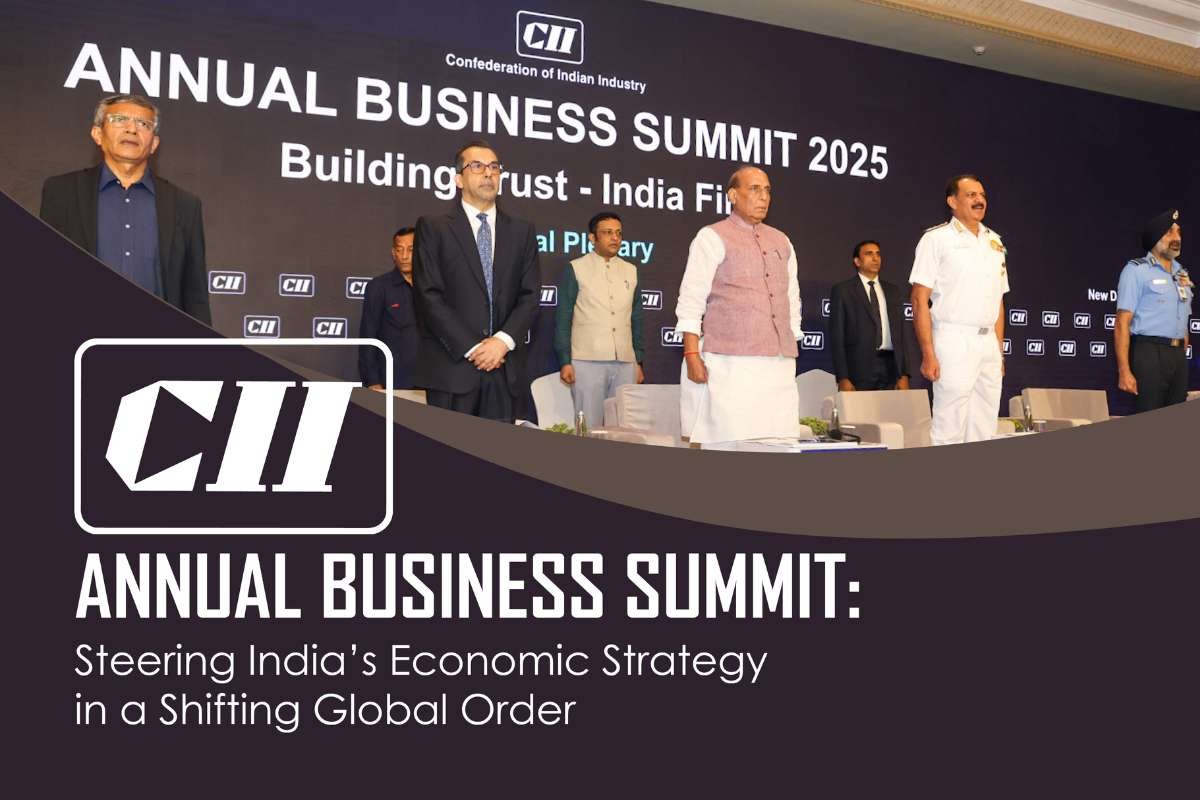


The CII Annual Business Summit is the flagship annual convening of the Confederation of Indian Industry (CII), India’s premier industry association and one of the country’s most influential institutional voices in economic policymaking. Over the years, the Summit has evolved into a cornerstone of India’s corporate and policy ecosystem, serving as a primary platform where the Government of India and industry leadership converge to deliberate on national economic priorities and long-term development pathways.
Held against the backdrop of rapid shifts in global trade, technology, geopolitics, and climate imperatives, the Summit plays a critical role in aligning policy intent with industry execution. It also reinforces India’s positioning as a credible, competitive, and trusted partner in the global economy.
Purpose and Strategic Relevance
At its core, the Summit functions as a bridge between policymakers and the private sector, enabling high-level dialogue on reform, regulation, and economic strategy. Its relevance is anchored in three broad objectives.
First, it facilitates policy dialogue, allowing industry leaders to engage directly with government decision-makers on regulatory frameworks, trade policy, fiscal priorities, and structural reforms. Second, it provides a forum for strategic roadmap-setting, helping the Indian industry align its capabilities with national objectives such as competitiveness, sustainability, and technological self-reliance. Third, it serves as a powerful networking platform, bringing together thousands of delegates, including CEOs, investors, diplomats, and global partners, to foster B2B and G2B collaboration.
In recent years, the Summit has also aligned closely with India’s long-term national vision, including the ambition of transforming India into a developed economy by the centenary of its independence.
Participation and Influence
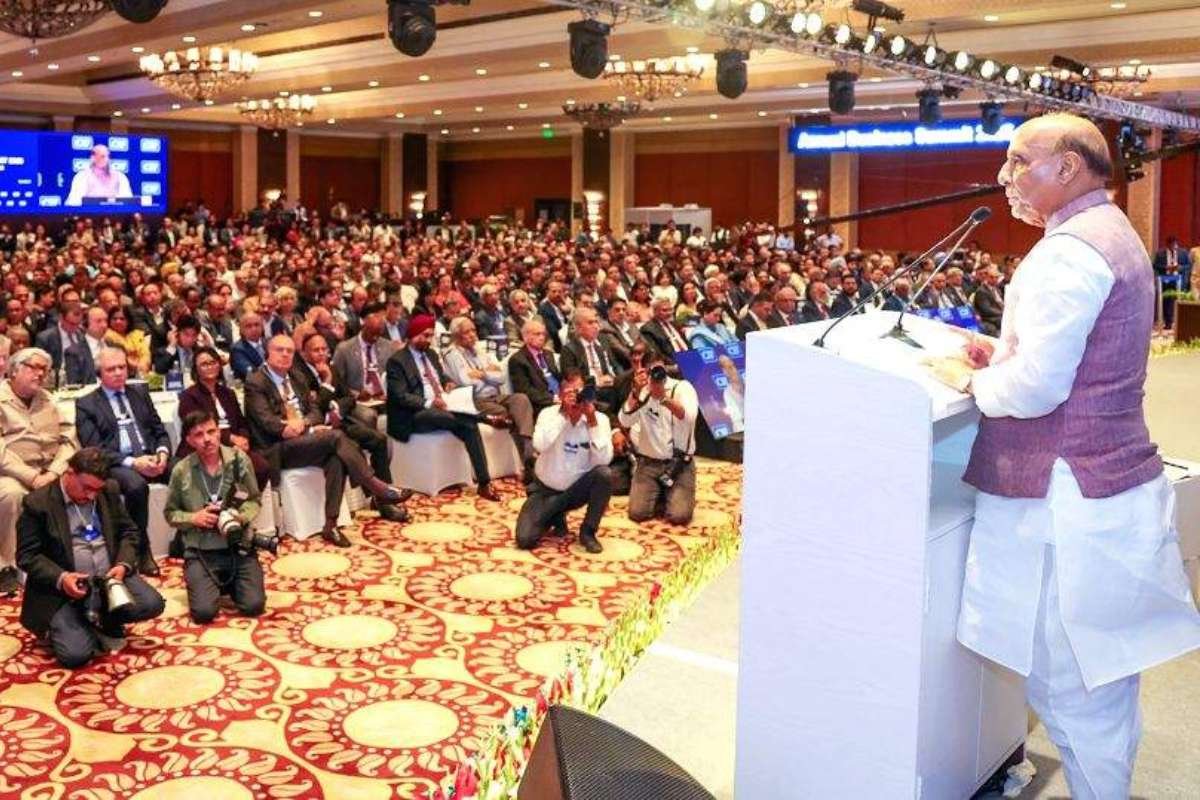
The CII Annual Business Summit consistently attracts participation at the highest levels of leadership. The Prime Minister of India often delivers the inaugural or special address, setting the tone for policy discourse and reform priorities. Senior Union Ministers across portfolios such as Finance, Commerce and Industry, External Affairs, Defence, Railways, Information Technology, and Environment lead focused sessions on sectoral and cross-cutting issues.
Alongside government leadership, the Summit brings together top Indian and global CEOs, multinational corporations, economists, policy experts, and representatives from international institutions. This convergence of stakeholders makes the Summit one of the most influential barometers of India’s economic direction and investment climate.
Summit Framework and Thematic Focus
Each edition of the CII Annual Business Summit is anchored around a central theme reflecting prevailing economic realities and future aspirations. While themes evolve year to year, they consistently emphasise trust, competitiveness, resilience, and global engagement, underscoring India’s dual priorities of domestic development and international partnership.
Key Tracks: The Five Strategic Pillars
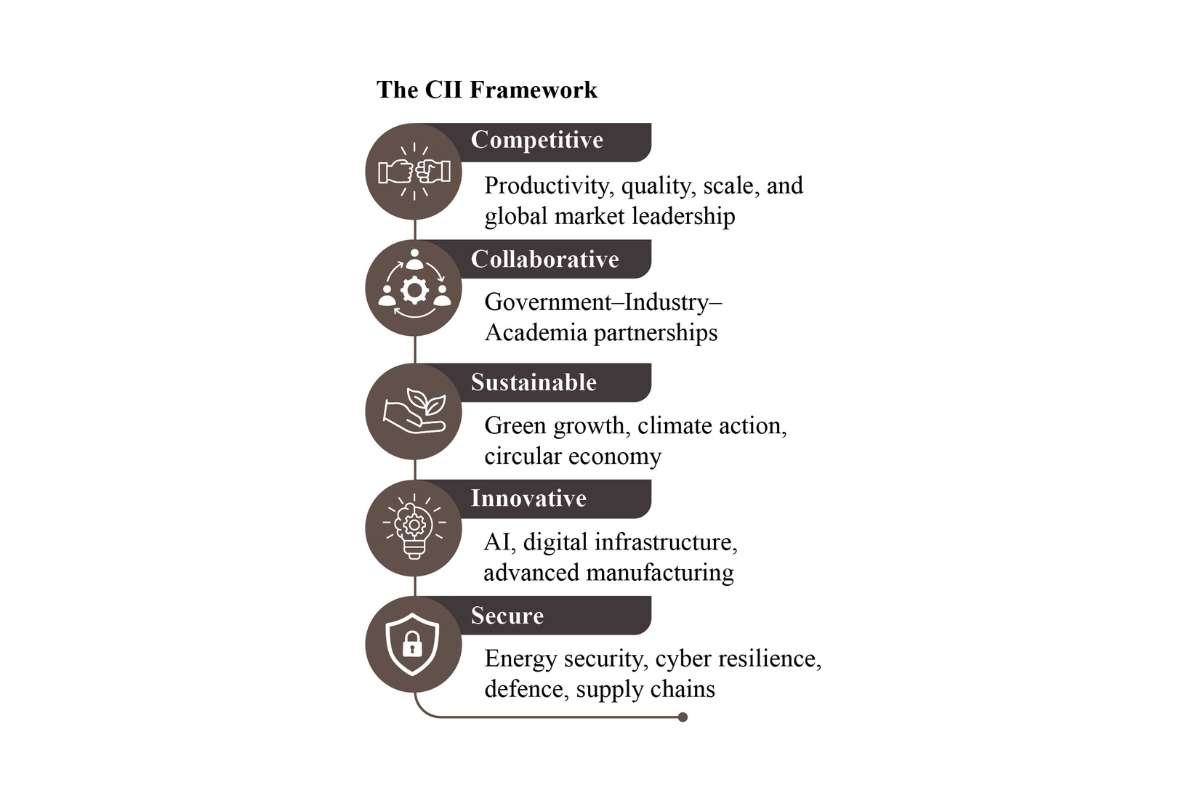
Discussions at the Summit are typically organised around five strategic pillars, which together frame India’s economic and industrial priorities:
- Competitive: Enhancing productivity, quality, and scale to strengthen India’s position in global markets.
- Collaborative: Deepening partnerships between Government, Industry, and Academia to accelerate innovation and effective policy execution.
- Sustainable: Advancing green technologies, circular economy models, and climate-resilient growth pathways.
- Innovative: Leveraging artificial intelligence, digital infrastructure, and advanced manufacturing to drive next-generation growth.
- Secure: Strengthening energy security, cyber resilience, defence capability, and supply chain integrity.
These pillars provide a coherent framework linking near-term reforms with long-term national objectives.
| The CII Framework | |
|---|---|
| Pillar | Strategic Focus |
| Competitive | Productivity, quality, scale, and global market leadership |
| Collaborative | Government–Industry–Academia partnerships |
| Sustainable | Green growth, climate action, circular economy |
| Innovative | AI, digital infrastructure, advanced manufacturing |
| Secure | Energy security, cyber resilience, defence, supply chains |
Policy Signals and Strategic Takeaways
A defining feature of the Summit is the clarity it provides on India’s economic trajectory. Ministerial addresses and leadership dialogues often signal priorities around growth, investment, manufacturing, technology adoption, and global integration.
Across editions, discussions have highlighted India’s sustained growth outlook, strengthening macroeconomic fundamentals, and the country’s expanding role in global value chains. Increasing emphasis has been placed on building India as a product and manufacturing-led economy, supported by domestic technology capabilities, resilient infrastructure, and modernised logistics systems.
The Summit has also consistently reinforced the importance of strategic autonomy, particularly in areas such as defence manufacturing, energy security, and critical supply chains, while promoting sustainability as an engine of long-term growth rather than a regulatory obligation.
Knowledge Outputs and Industry Guidance
Beyond dialogue, the CII Annual Business Summit serves as a launchpad for key reports, frameworks, and institutional initiatives that guide industry action. These typically include:
- CII Theme Papers outline strategic priorities for the Indian industry across competitiveness, sustainability, and global engagement.
- Frameworks on climate finance and sustainability, supporting industry access to green capital and responsible investment.
- Guidance on ethical business practices and supply chain transparency, reinforcing trust and resilience.
- ESG and non-financial reporting toolkits, helping companies navigate evolving disclosure norms.
- Technology and innovation initiatives, including platforms to accelerate AI adoption and digital transformation.
These outputs ensure that the Summit’s impact extends well beyond the event itself.
Why the Summit Matters for Business Leaders?
For business professionals, the CII Annual Business Summit is a critical reference point. It offers early insight into policy direction, reform momentum, and sectoral focus areas, helping enterprises anticipate regulatory and market shifts. The Summit also highlights investment themes, ranging from advanced manufacturing and clean energy to AI and defence, while providing a clear sense of global investor sentiment toward India.
Equally important, it enables senior leadership engagement across sectors, making it a unique platform for strategic partnerships and long-term collaboration.
CII: A Legacy of Institution-Building
The authority of the Summit is rooted in CII’s 130-year institutional legacy. Established in 1895 as the Engineering and Iron Trades Association, the organisation evolved through multiple phases, EITA, IEA, EAI, AIEI, and CEI, before becoming the Confederation of Indian Industry in 1992 following India’s economic liberalisation.
Today, CII represents around 9,700 direct members and an indirect base of over 365,000 enterprises, making it India’s most visible and impactful industry body.
Leadership and Governance
CII is led by senior industry leaders who bring deep experience across policy, finance, and enterprise-building. The organisation’s leadership plays an active role in shaping public discourse on economic reform, competitiveness, and sustainable development, reinforcing CII’s role as a trusted partner to government and industry alike.
The Road Ahead for India’s Economic Leadership
The CII Annual Business Summit is not merely an annual gathering; it is a strategic institution shaping India’s economic narrative. Convening government and industry leadership at the highest level, it ensures that India’s growth ambitions remain aligned with policy clarity, execution capability, and global credibility. As India advances toward its long-term development goals, the Summit will continue to play a central role in building a competitive, inclusive, sustainable, and trusted economic future.